
India-US Trade Deal 2026: India and the United States are presently in the last stages of negotiations of a historic Interim Trade Agreement (ITA). In fact, the framework was agreed upon in February 2026, and chief negotiators from both countries are going to meet in New Delhi from June 1 to June 4, 2026. Earlier, the U.S. considered to reduce its baseline tariff on Indian goods to \(18\%\). Finalizing this interim agreement before July 24 would shield India from Section 301 tariffs.
India will reduce or remove tariffs on U.S. industrial and agricultural goods. Moreover, they include fresh/processed fruits, tree nuts, soybean oil, and red sorghum. India is to purchase over \(\$500\) billion of U.S. energy (including coal and petroleum). Furthermore, both countries will expand technological cooperation. They will collaborate on covering supply chains for critical minerals and rare earths. In addition, the U.S. lifted penalties and tariffs tied to the importation of Russian Federation oil.
The understanding is that India will curtail Russian imports. Overall, this is part of the broader diplomatic efforts surrounding the deal. This outlines a commitment to establish bilateral digital trade rules. Most importantly, it will address to the discriminatory practices and digital barriers. In other words, India shall eliminate or reduce tariffs on US industrial goods. This will include agricultural products (including fruits, tree nuts, and wine). In return, the US is to grant preferential market access.
This trade agreement aids the “Mission 500” initiative. Above all, it aims to almost double the bilateral trade to (\$500\) billion by 2030. India will make massive strategic purchases of US energy, technology, and aircraft over the coming years.
India - US strategic bilateral partnership
India – US strategic bilateral partnership lies in shared democratic values, economic ties, and mutual security interests. In fact, the converging geopolitical strategies run this bilateral trade. This partnership spans defence, technology, space, and energy.
Overall, the previous iCET framework upgrades the trade agreement. The US-India TRUST Initiative expands technology cooperation.
Similarly, this goes across artificial intelligence, semiconductors, quantum computing, and biotechnology. The deep collaboration involves partnerships in human spaceflight and a roadmap for joint defence industrial cooperation. Most importantly, the US and India have reduced tariffs on key industrial goods and agricultural products. They aim at stabilizing long-term economic prosperity.
Both nations are reducing dependencies on single-source monopolies (such as China). Thus, they are advancing pharmaceutical and electronic supply chains. India holds “Major Defence Partnership” status. This helps them enjoy significant exemptions in strategic trade licensing. Moreover, crucial bilateral pacts support inter-operability. They include the Logistics Exchange Memorandum of Agreement (LEMOA), Communications Compatibility and Security Agreement (COMCASA), and Basic Exchange and Cooperation Agreement (BECA).
The US and India formally signed a bilateral Critical Minerals Framework. Furthermore, this ensures resilient supply chains for advanced technology and clean energy. The US and India are core members of the Quadrilateral Security Dialogue. In addition, they will cooperate for a free, open, and rules-based Indo-Pacific order. Through regular bilateral dialogues, both countries maintain close intelligence sharing and operational cooperation. Likewise, India & the US pledged to deepen defence and security cooperation. Greater maritime and space domain awareness are the key areas they will work on.
Inconclusion, exchange of Information and sharing military liaison personnel is the crucial area to work upon. Advanced training and expanded exercises between all services and special forces are key sectors.
Impact of India US Trade Agreement on Exports
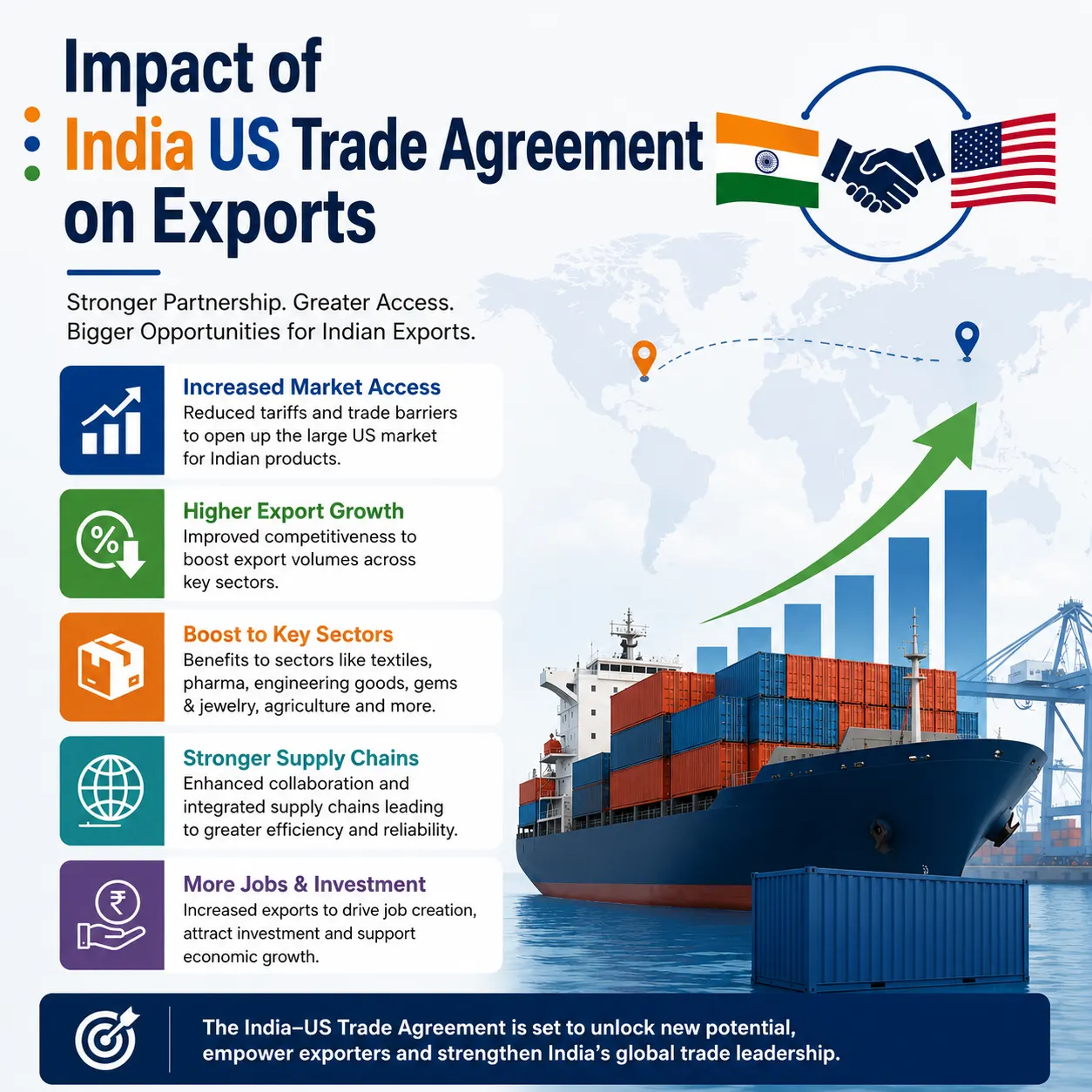
There will be tremendous Impact of India US Trade Agreement on Exports. In fact, this trade deal significantly boosts India’s export economy. It has slashed tariffs on tens of billions of dollar worth of goods. Most importantly, the deal lowers reciprocal tariffs on Indian exports to 18% (down from up to 50%). This secures zero-duty access to key industrial and consumer goods. Overall, it restores and multiplies Indian price competitiveness.
By reducing tariffs, they have protected the labour-intensive clusters. In other words, this positions India as the preferred supplier in the US footwear and broader textile markets. It is worth $42 billion. After this, the US imports nearly 40% of its generic medicines from India. The deal solidifies this market share. In fact, $19 billion US investment commitments are into India’s pharmaceutical manufacturing. The agreement grants zero additional duty access for industrial exports. Most importantly, they have a value at $38 billion.
Machinery and nuclear reactor exports now face an 18% tariff (down from 50%). Therefore, the tariff rationalization prevents retaliatory escalations. This stabilizes trade for India’s traditional high-value export segments. In a nutshell, the US is India’s largest single-country export destination (accounting for about 22% of total global exports). The agreement removes significant trade volatility. In conclusion, the framework serves as an economic stabilizer. It focusses immensely on technology and energy.
Conclusion
The India-US Bilateral Trade Agreement is in its final stages. Overall, the negotiators are expecting the formal deal to be signed in the coming weeks and months. An interim framework was announced on February 7, 2026. Moreover, the working-level delegations are currently resolving the remaining details. They are to finalize the comprehensive package. Furthermore, the US is moving to cap reciprocal tariffs on Indian goods at 18%. A punitive 25% tariff on Indian goods tied to India’s Russian oil purchase has also been effectively removed.
With lowered US reciprocal tariffs on Indian goods and India’s shift to US energy and engineering products, Falcon acts as a vital bridge for importers and exporters.
Furthermore, Falcon Freight assists in navigating changing tariff frameworks. It utilizes customs house brokerage (CHA) at major ports. In addition, this ensures duty reductions are applied correctly.
For more information:
Phone No. :- +91 9311595648.
Email :- cargodeal@falconfreight.com