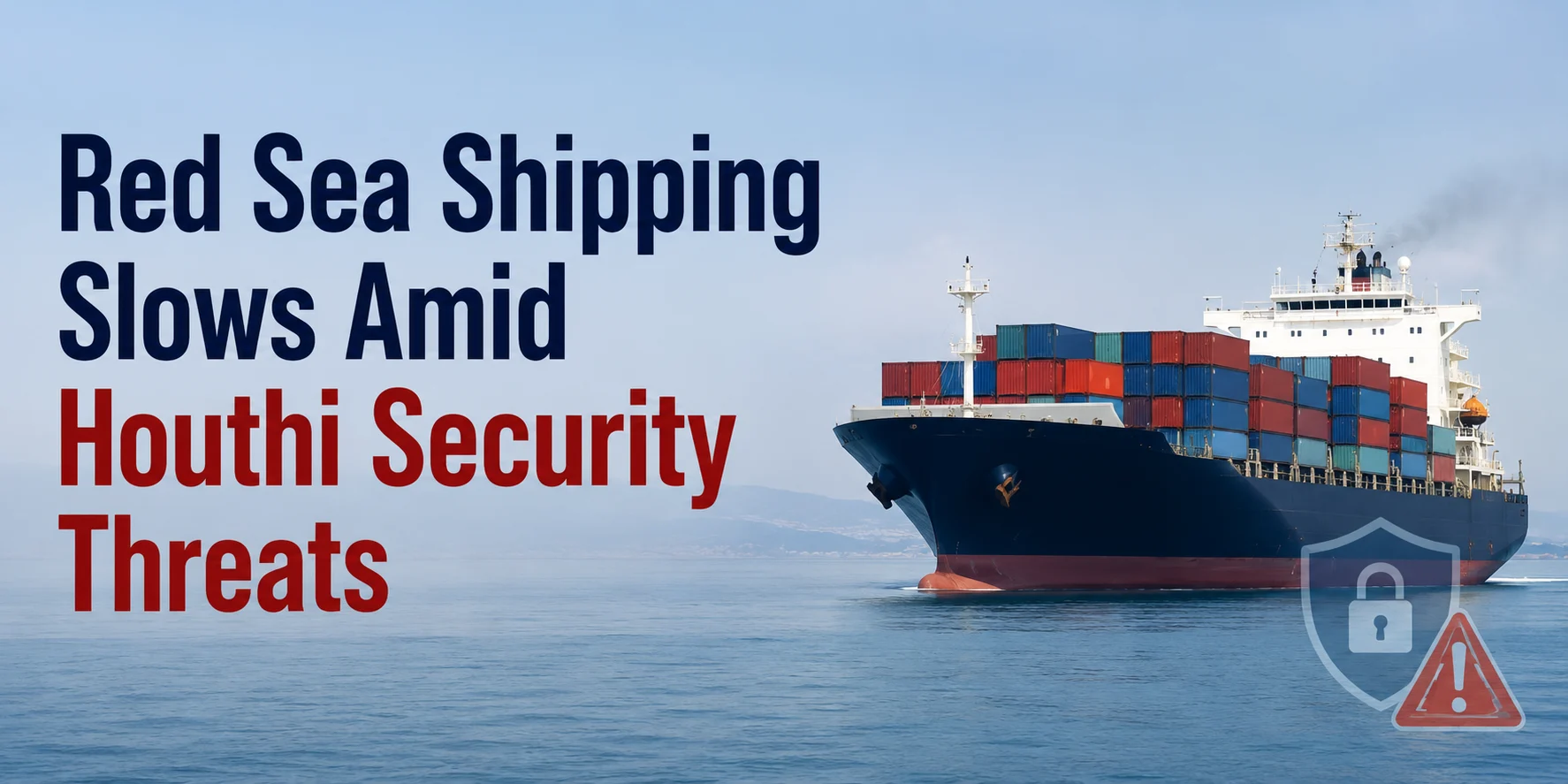
Red Sea Shipping Slows Amid Houthi Security Threats
Global maritime trade is facing growing disruptions as security concerns continue to affect one of the world’s busiest shipping corridors. Red Sea Shipping Slows Amid Houthi Security Threats as war-risk insurance suspensions and forced diversions around Africa’s Cape of Good Hope compel shipping lines to reroute vessels. These extended routes increase transit times, fuel consumption, freight costs, and operational challenges for carriers.
As a result, traffic through the Bab el-Mandeb Strait has fallen to an average of 31 transits per day, with transit volumes declining significantly by late July 2026. Shipping companies are also facing higher insurance premiums, vessel scheduling delays, and increased uncertainty, leading many operators to avoid the Red Sea route.
Renewed Houthi militant attacks, naval blockades near the Bab al-Mandeb Strait, and escalating military conflicts have led cargo ships to avoid the Red Sea.
In the first place, renewed U.S. and Iranian hostilities have made the Strait of Hormuz and the southern Red Sea extremely volatile.
Recently, missile and drone strikes hit oil tankers like the Ancelia near Jizan.
The key point to note is that these strikes have ignited fires and triggered distress calls.
Moreover, this crisis has forced vessels to take longer routes, turn off tracking signals, and face surging insurance costs.
For this reason, the rerouting has added weeks to transit times and millions in extra fuel costs.
Above all, some vessels turn off their Automatic Identification System (AIS) transponders to sneak past the Bab el-Mandeb Strait invisibly.
Persistent security threats and insurance restrictions in the Red Sea have completely altered global trade. This has significantly reduced vessel traffic through the Bab el-Mandeb Strait. Most importantly, this shift has resulted in long-term operational strains. Alongside this, it has increased costs and delivery delays.
Falcon Freight helps mitigate Red Sea shipping slowdowns through flexible multimodal routing, regional consolidation expertise, and active shipment tracking. We also help utilise advanced tracking systems and pre-arrival data transfer to speed up terminal handovers.