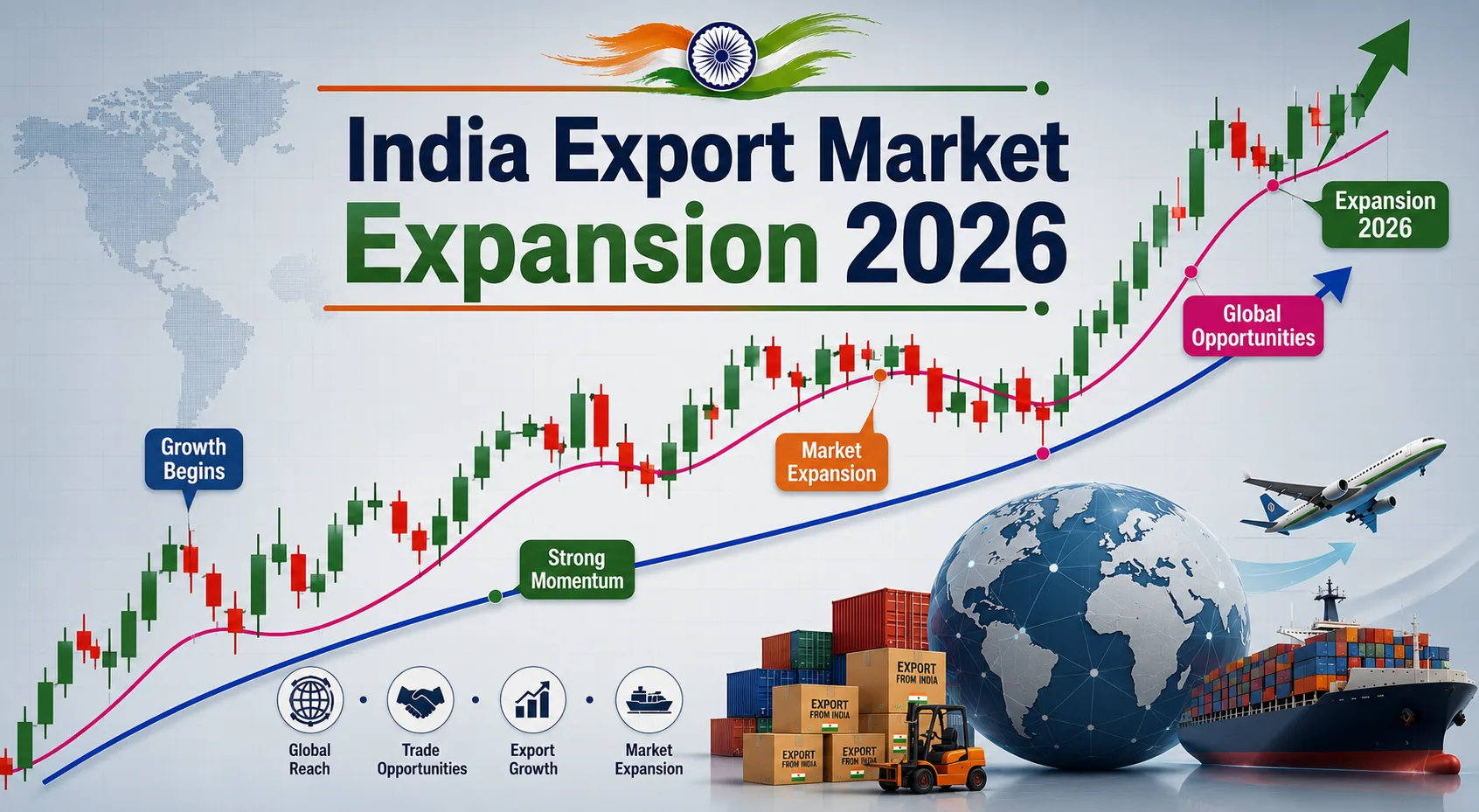
India Export Market Expansion in 2026 is happening with merchandise and services exports reaching $80.8 billion. In fact, exporters explored into more than 1,821 new global product-country markets. How India’s Exports Are Growing in 2026 is evident from the strong performance of sectors such as ships, boats, and telecom instruments, which are driving growth to another level. Despite geopolitical upheavals, India’s exports are growing at a rapid pace. Furthermore, the government has aimed at a mission hitting $2 trillion in overall exports in the coming five years. More than 20 export sectors have successfully penetrated 17 or more new global markets.
Electronics, pharmaceuticals, high-value manufacturing, engineering goods etc are leading the expansion alongside traditional agriculture and textiles. In addition, India is racing ahead with market access through strategic trade pacts. These include negotiations on the India-EU FTA, and targeted agreements with the UK, Oman, and New zealand. They help secure long-term investments and better regulatory environments.
The Remission of Duties and Taxes on Exported Products (RoDTEP) and the newly approved Export Promotion Mission (EPM) are boosting prospects of expanding exports. So, such schemes help neutralize embedded taxes to keep Indian products highly competitive globally.
The Union Commerce Ministry has been officially introduced to help connect local businesses. Moreover, it will link global export networks to enhance domestic manufacturing. The services sector currently contributes about 49% of India’s total exports. Overall, it has risen from 39% in 2014, emphasising the growing importance of knowledge-driven sectors.
In the Electronics and PLI Integration, India has tremendously transformed its electronics ecosystem. In fact, it has elevated from basic assembly to high-value global manufacturing through targeted state-backed financial incentives. The paradigm shift effectively reduced the critical import dependencies. Above all, Mundra port, Nhava Sheva port, Kandla port, Chennai Port, Vishakhapatnam Port and Cochin port are some of India ‘s major export ports.
FTA (Free Trade Agreement) Policy & Exports
Free Trade Agreements (FTAs) policy & exports reduce tariffs, quotas, and non-tariff barriers. In a nutshell, these policies and agreements successfully expand market access for domestic exports. The recent massive FTA expansions are opening significant zero-duty advantages across international markets. Thus, this is enhancing growth in labour-intensive sectors like textiles, chemicals, and engineering goods. India has rapidly expanded its FTA footprint.
- It has reached 39 countries through strategic agreements. These agreements are framed to enhance regional trade and supply chain integration. Meanwhile, India Export Market Expansion in 2026 is happening with merchandise and services exports reaching $80.8 billion. Mundra port, Nhava Sheva port, Kandla port, Chennai Port, Vishakhapatnam Port and Cochin port are some of India ‘s major export ports.
- India-EU Free Trade Agreement opens up the huge USD 500 billion European market. Additionally, it secures zero duty on 97.5% of India’s chemical export basket. It has raised the labour-intensive textile exports to a USD 263.5 billion demand market. Most importantly, the EU will remove duties on almost all Indian exports. This will allow for economical imports on fully built luxury vehicles (e.g., BMW, Mercedes, Audi) and specialized engineering components from Europe.
- India-New Zealand FTA eliminates duties on 100% of Indian exports. It grants zero-duty access for crucial labour-intensive MSME sectors like textiles, leather, and gems & jewellery.
- India-UK CETA is signed to deepen trade and technology partnerships with the UK, one of Europe’s largest economies.
EFTA TEPA came into force, effectively reducing tariffs an boosting engineering exports to EFTA nations (Switzerland, Norway, Iceland, Liechtenstein).
USA Interim Agreement offers a formalized framework for enhanced market access and technology collaboration with the United States.
Falcon Freight helps Indian exporters expand their global footprint. It does so by providing end-to-end freight forwarding, customs clearance, and global shipping solutions.
To know more about : india and south koreas fta free trade agreement ; click here 🔁
FTA- Led Exports
FTA- Led Exports drive exports, helping trades expand into global markets. Thereby they reduce it by reducing or eliminating tariffs. FTAs permit you to export goods at lower or zero duty rates. Overall, they make your products more competitive against rivals from non-FTA countries. To avail the benefits, your exported products must meet specific “rules of origin” criteria. Furthermore, they evidently are effectively transformed or manufactured within your country.
Through the Director General of Foreign Trade (DGFT) Portal, you can check the eligibility of your products, find tariffs, and apply for Certificates of Origin. Moreover, they automate export documentation, and track shipments in real-time. In addition, you can generate commercial invoices, and file for customs declarations.
India Export Market Expansion in 2026 is happening with merchandise and services exports reaching $80.8 billion. In fact, Free Trade Agreements (FTAs) policy & exports reduce tariffs, quotas, and non-tariff barriers. Mundra port, Nhava Sheva port, Kandla port, Chennai Port, Vishakhapatnam Port and Cochin port are some of India ‘s major export ports.

Conclusion
India’s export sector significantly achieved a historic milestone. In other words, it hit nearly \(\$863\) billion in total exports for FY26. This showcased incredible endurance and diversification despite geopolitical tensions in West Asia. However, as the ecosystem transits to intermediate and tech-led trade, bridging credit gaps and adopting digital logistics will be crucial. The government continues to ease trade barriers.
Falcon freight assists with smart freight planning and cost optimization to counter rising war surcharges and global freight rate volatility. They can also handle heavy-load sea freight (FCL/LCL) as well as urgent time-sensitive air freight to global markets.
For more information:
Phone No. :- +91 9311595648.
Email :- cargodeal@falconfreight.com