
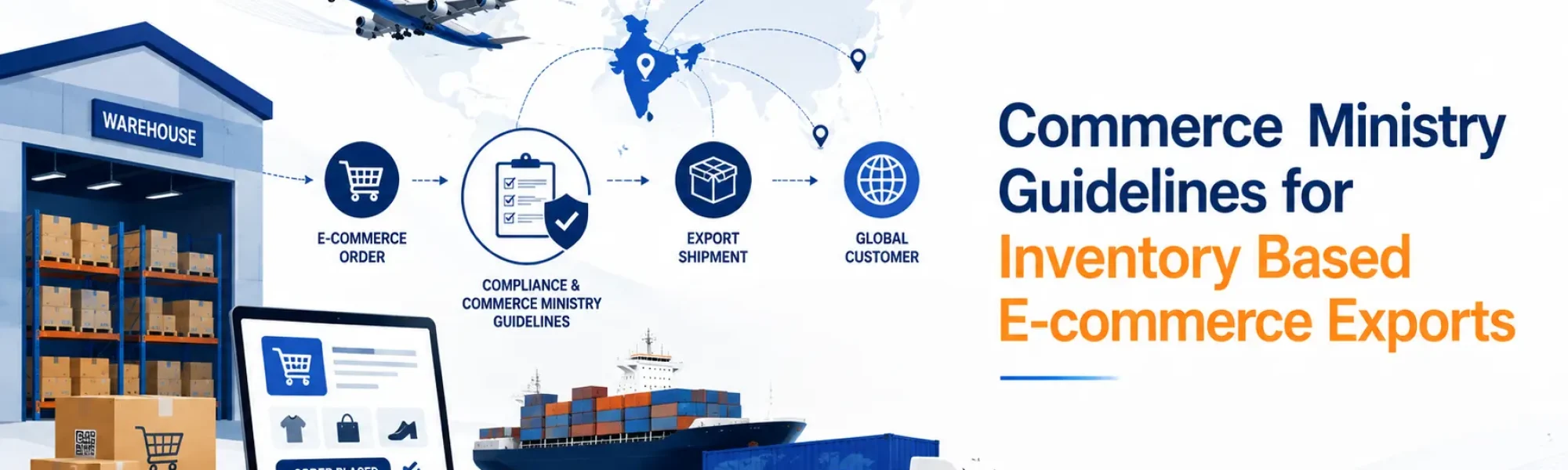
Commerce Ministry Guidelines for Inventory Based E-commerce Exports
The Commerce Ministry guidelines for inventory – based e-commerce exports provide Indian manufacturers, artisans and MSMEs access to global markets. To begin with, the framework enables exports of goods manufactured or produced in India while safeguarding the interests of Indian sellers.
In addition, eligible e-commerce entities may undertake export-only inventory operations through a registered Exporter-on-Record (EOR).
Furthermore, the EOR obtains goods from Indian Sellers-on-Record (SORs) against confirmed overseas orders, and assumes responsibility for export operations as well as compliance with destination-country requirements.
Moreover, Indian sellers can access overseas markets while delegating export documentation, customs formalities, destination-country regulatory compliance, product testing and certification, packaging, labelling, fulfilment, logistics and reverse logistics to the EOR.
India's New E-Commerce Export Norms
The foreign-funded e-commerce firms can hold inventory and buy made-in-India goods directly from local sellers under India’s New E-Commerce Export Norms.However, it is strictly meant for outbound shipments against confirmed international orders rather than domestic retail.
Financial and Compliance Rules:
Seller Payments: EORs must pay local sellers within seven days of accepting goods, regardless of international buyer payments.
Export Benefits: Rebates and refunds have to pass through to sellers proportionally within 30 days.
Fee Caps: The administrative charges for EORs are capped at 10% of gross refunds.
Returns: Rejected items require re-export, return to origin, and proper disposal.
Notably, the framework also ensures timely payment to sellers, transparency in overseas sales and clear accountability for export compliance.
Thereby, it reduces compliance costs and enables Indian enterprises to focus on production and innovation while expanding their global market access.
In essence, speculative inventory build-up for export purposes is not permitted.
Above all, the export inventory must be distinctly identified, and maintained through a digital repository to ensure traceability.
Most importantly, the framework provides for timely payments to Indian sellers within a prescribed timeline, irrespective of the receipt of payment from overseas buyers.
Export rebates and refunds must pass through to the Sellers-on-Record in proportion to the FOB value attributable to their goods.
On top of this, sellers get transparency regarding the final sale price, order status and shipment tracking of their products.

Conclusion
The Commerce Ministry’s inventory-based e-commerce export guidelines successfully balance global market expansion with strict domestic retail protections. By allowing foreign-invested firms to hold export-only inventory through Exporters-on-Record (EOR), the policy empowers local MSMEs while keeping domestic B2C rules safely intact.
Additionally, returned or rejected consignments must be re-exported, returned to the seller or disposed off in accordance with the prescribed procedures. To further strengthen transparency and enforcement, the framework mandates annual compliance certification and maintenance of digital records.
Falcon Freight assists Indian sellers and e-commerce exporters in complying with the Commerce Ministry’s Inventory-Based Cross-Border E-Commerce Framework by streamlining international shipping, handling digital export documentation, and supporting structured customs and logistics under updated Foreign Trade Policy guidelines.
For more information:
Phone No. :- +91 9311595648.
Email :- cargodeal@falconfreight.com