Project Cargo Logistics in India
What is Project Cargo Logistics?
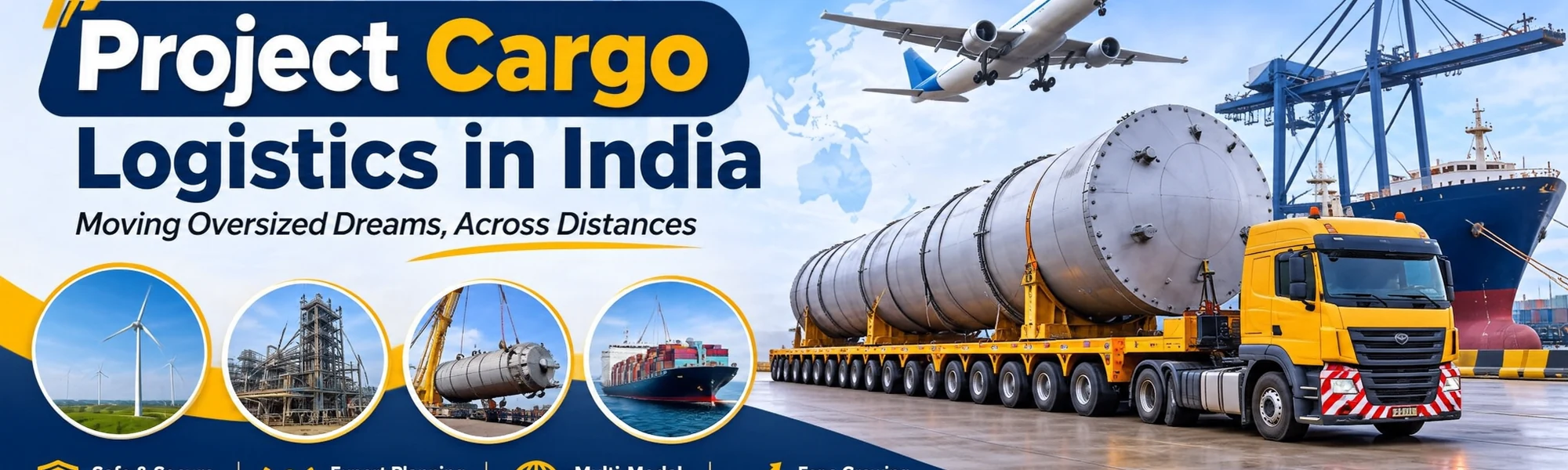
Project cargo logistics includes planning as well as transportation of goods from one place to another. However, it includes only heavy, oversized, and high-value goods that cannot fit in standard containers. As a result, it requires coordination between multiple agencies and multi-modal transportation. To ensure the commodity reaches the final destination without damage, the consignment goes through ocean freight, air freight, rail, and road transport. According to the IAPH (International Association of Project Cargo), any cargo can be considered project cargo if it requires special arrangements due to its shape, size, fragility, or weight. Therefore, in practice, this means cargo that exceeds 20 feet in length, 8.5 feet in height, and 8 feet in width. Moreover, to be eligible for project cargo logistics, an item must weigh more than 21,700 kg.
Hence, to transport a commodity that falls outside standard container limits, businesses require a tailor-made logistics solution.
Type of Project Cargo
Over-Dimensional Cargo
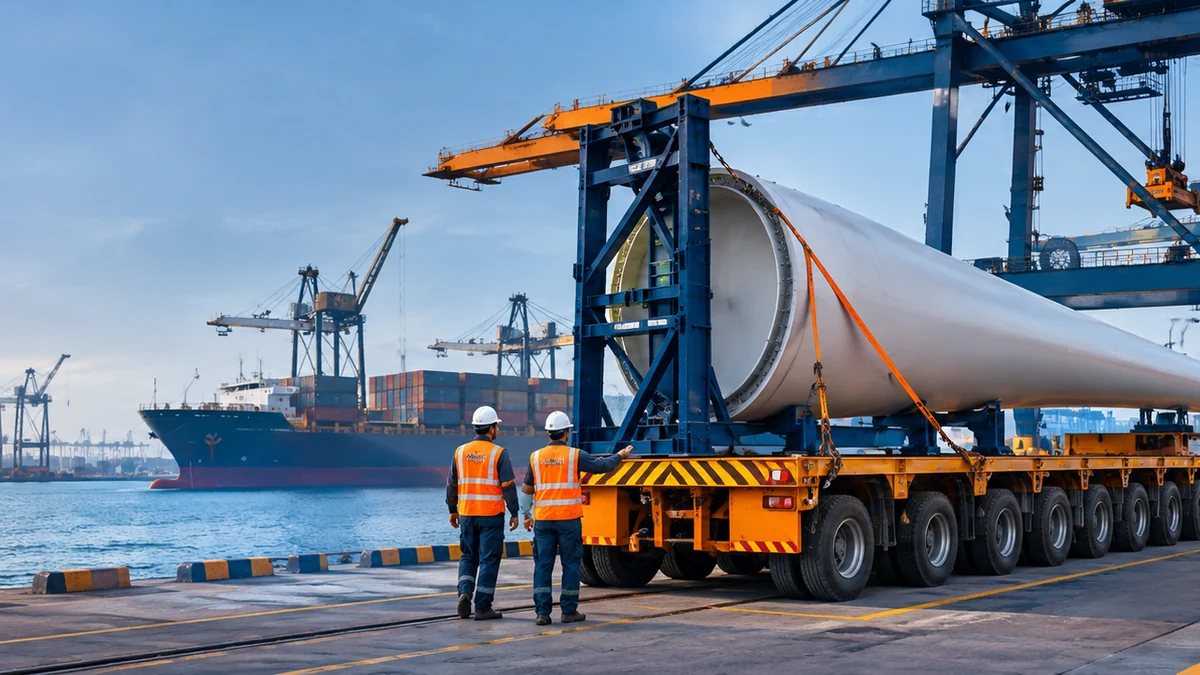
Heavy-Lift & Super Heavy-Lift Cargo
Breakbulk Cargo
Likewise, breakbulk cargo consists of individual goods transported separately rather than inside standard shipping containers. As a result, operators use cranes or other specialised equipment to load, secure and unload each item. individually.
Roll-on/Roll-off (RoRo) & Self-Propelled Cargo
RoRo cargo or self-propelled cargo refers to wheeled vehicles and equipment. Therefore, they can be driven or rolled directly onto and off the vessel. Hence, this makes loading and unloading easier, as they do not require lifts or cranes for movement.
Modular & Turnkey Plant Cargo
It includes large industrial structures, machinery, or plant equipment. It is transported in separate modules for assembly at the final project location. Hence, under modular and turnkey plant cargo, the commodities are transported through multiple shipments.
Difference Between Project Cargo Types
| Type | What Makes it Different? | Transportation Requirement |
|---|---|---|
|
Over-Dimensional Cargo |
Exceeds permissible length, width, or height limits |
Specialised trailers and route planning |
|
Heavy-Lift and Super Heavy-Lift Cargo |
Exceeds conventional lifting capacity due to its weight |
Heavy-duty cranes and hydraulic lifting systems |
|
Breakbulk Cargo |
Transported as individual pieces rather than in standard containers |
Individual loading, securing, and unloading |
|
Roll-on/Roll-off (RoRo) & Self-Propelled Cargo |
RoRo vessels and loading ramps |
Can be driven, rolled, or moved onto transportation vessels |
|
Modular & Turnkey Plant Cargo |
Consists of multiple components required for an industrial facility |
Coordinated transportation of modules and plant equipment |
Industries Using Project Cargo
- Renewable Energy
- Powerplants
- Aerospace
- Engineering
- Military and Defense
- Petrochemical Fields
Multimodal Transportation in Project Cargo Logistics
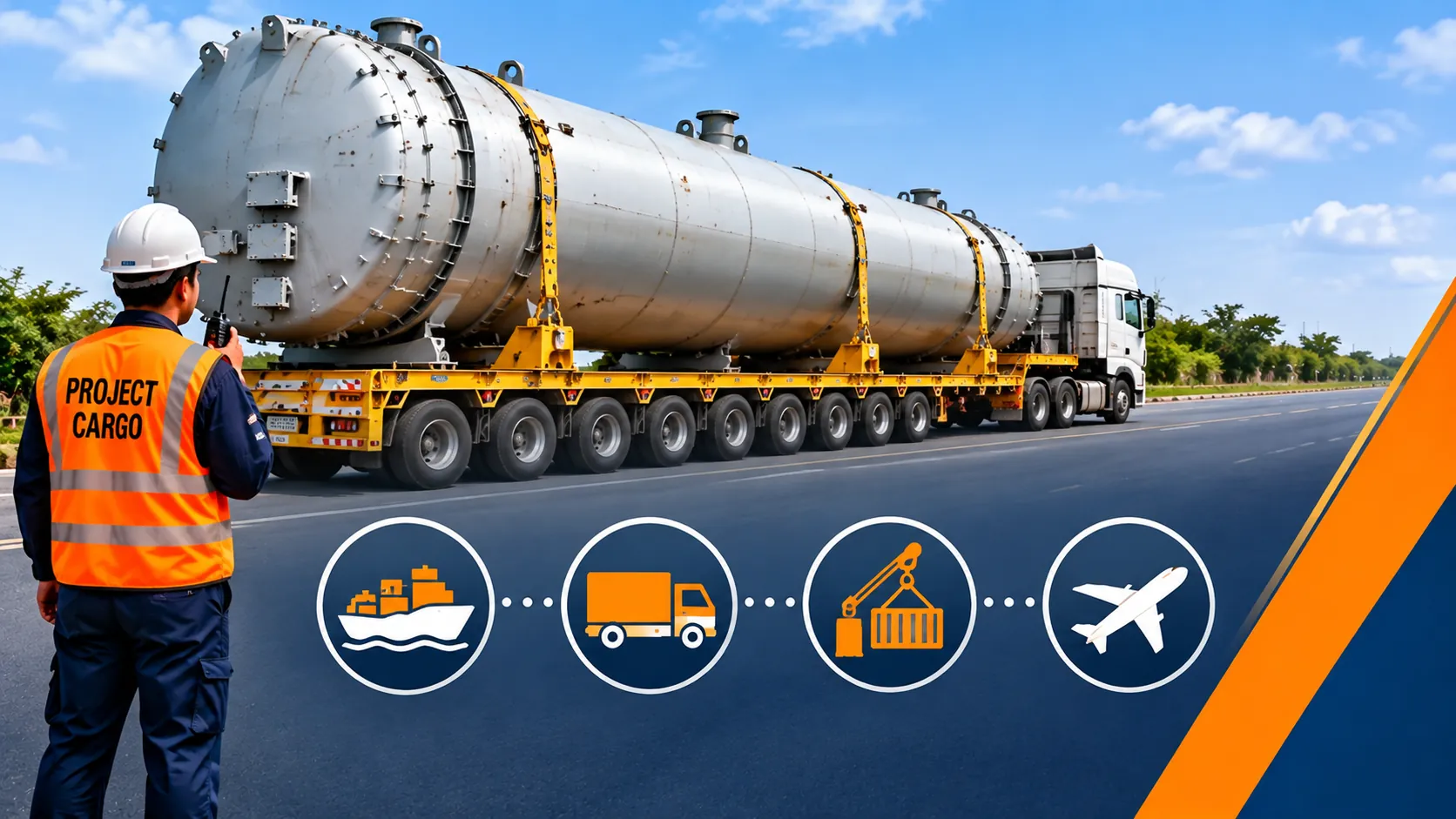
Multimodal transportation includes a combination of two or more transport modes under a single logistics service to move oversized cargo from one location to another. As mega-projects like renewable energy projects, aerospace, military, and more are situated away from seaports, relying on a single mode of transport is not an option. Hence, project cargo logistics require multimodal transportation.
Multimodal transportation planning is beneficial for project cargo for several reasons. First, it minimises transhipment points. This is because every transfer poses a risk of damage to the cargo and adds to the overall cost of transportation. Therefore, under multimodal transportation, planners create a hook-to-barge system whenever possible. Similarly, planners organise a synchronised schedule to avoid shipment delays. Additionally, the same operator handles the multimodal transportation. As a result, in case of an accident, a single party is liable for the losses.
Challenges in Project Cargo Management
- Infrastructure and Physical Bottlenecks
- Regulatory and Compliance Barriers
- Seasonal and Environmental Disruptions
- Supply Chain Synchronisation
- Cost Escalation
- Safety, Cargo Integrity and Risk Management
- Engineering and Technical Complexity
Equipment Required For Project Cargo Handling
Road Transport Equipment
Firstly, the planners use this equipment to move extremely heavy cargo across highways and rural project roads. Some of this equipment includes:
-
- Hydraulic Multi-Axle Modular Trailers (HMTs)
- Self-Propelled Modular Transporters (SPMTs)
- Schnabel Trailers
- Extendable & Low-Bed Semi-Trailers
- Puller-Pusher Prime Movers
Heavy Lifting and Rigging Equipment
To hoist and position the cargo, the planners use heavy lifting and rigging equipment at ports, rail sidings, and project foundations. It includes:
-
- Heavy Crawler & All-Terrain Cranes
- Hydraulic Gantry Systems
- Strand Jacks
- Custom Spreader Beams & Lifting Frames
Horizontal Positioning and Foundation Placement
Similarly, planners use horizontal positioning and foundation placement systems for last-meter installation. These are used when cranes cannot reach the final foundation. It consists of several pieces of equipment and systems, such as:
-
- Hydraulic Jacking & Skidding Systems
- Heavy-Duty Air Casters & Rollers
- Steel Load-Spreading Mats
Marine and Rail Transfer Equipment
Finally, marine and rail transfer equipment is used for cross-border shipping, coastal barging, and long-haul inland rail legs. Some of this includes:
-
- Geared Heavy-Lift Vessels
- Flat-Top Deck Barges & RoRo Ramps
- Rail Well Wagons & Schnabel Rail Cars
Documents and Permits For Project Cargo
Customs Valuation Documents
MoRTH ODC/OWC Movement Permission
State Road Authority Permission
Local Traffic Police Approval
Route Survey and Clearance Approval
Utility Clearance
Step-by-Step Framework of Project Cargo Handling
- Early Engineering and Feasibility Study (6–12 Months Prior): Firstly, the operators review manufacturer General Arrangement drawings, exact dimensions and weights, and more. Also, they determine whether the commodity must be shipped whole or split into smaller shipments. Lastly, the planners define risk transfer points and budget.
- Physical Route Survey and Transport Engineering (3–6 Months Prior): Secondly, the organisers conduct physical ground surveys from the origin to the destination port. The company, therefore, creates engineering plans, including calculations and loading plans.
- Statutory Permits, Customs and Insurance Setup (2–4 Months Prior): Under this, the planners apply for permits and certificates. Moreover, they register contracts on ICEGATE before cargo arrives. The company also purchases marine cargo insurance. Furthermore, it appoints a Marine Warranty Surveyor to audit critical lifting and lashing.
- Vendor Contracting and Equipment Mobilisation (1–3 Months Prior): The organisers lock in vessels, hydraulic multi-axle trailers, crawler cranes, and more ahead of monsoon or peak construction windows. Furthermore, they construct temporary bypass roads, steel bridge reinforcements, and more.
- Cargo Packing and Tracking: Moreover, to secure cargo, the company applies weatherproof wrapping. The planner additionally coordinates arrival with the availability of a port berth and inland trailer.
- Port Arrival, Customs Clearance, and Discharge: Furthermore, the organiser files documents in advance so the customs process is completed before the vessel arrives at the destination. Secondly, the organiser also discharges cargo directly onto waiting hydraulic trailers and coastal barges to avoid port storage charges and double handling.
- Inland Multimodal Haulage and Convoy Management: Here, the planning company moves cargo along the approved corridor. Moreover, they track the cargo movement in real time via GPS and maintain daily progress logs.
- Site Delivery, Rigging & Foundation Placement: Finally, the organising company uses heavy cranes, gantry systems, hydraulic jacking, and more to place the equipment directly onto anchor bolts.4
Role of Technology in Project Cargo Management
| Project Phase | Key Technology Used | Primary Operational Benefit |
|---|---|---|
|
Route and Lift Planning |
3D Swept-Path CAD
LiDAR Drones
Digital Twins |
Eliminates physical collision and bridge-load failures |
|
Ocean and Inland Transit |
IoT Shock/Tilt Sensors
AIS/GPS Control Towers |
Prevents cargo damage and reduces crane/vessel demurrage |
|
On-Site Positioning |
Computer-Controlled SPMTs
Synchronized Strand Jacks |
Achieves millimeter-level foundation placement accuracy |
|
Customs and Permits |
ICEGATE e-Sanchit
MoRTH ODC Portal
Blockchain e-BL |
Cuts border dwell times and paperwork errors |
India’s Infrastructure Readiness for Project Cargo Logistics
- Mundra Port: Located in Gujarat, the port is ready for floating cranes up to 800 MT, RoRo, and heavy ODC berths.
- JNPA (Nhava Sheva): Located in Mumbai, JNPA has expanded to support project cargo logistics. Therefore, it has the capacity to handle shore cranes up to 200 MT. Moreover, it handles flat-rack/open-top OOG and breakbulk.
- Mumbai Port: Also located in Maharashtra, Mumbai Port can handle breakbulk and heavy-lift berths under project cargo logistics.
- Hazira Port: Situated in Gujarat, Hazira Port is well-known for shore/heavy-lift operations up to 400 MT, as well as Ro-Ro jetties.
- Visakhapatnam Port: The port stands on the Eastern coastline of India. It can handle heavy-lift up to 300 MT. Additionally, it has a deep-draft capability of 18 m.
- Kolkata/Haldia Dock: Also on the Eastern coast of India, Kolkata/Haldia Dock supports cranes up to 150 MT.
Future of Project Cargo Logistics in India
Conclusion
To conclude, project cargo logistics is more than just shipping products from one place to another. It requires precise planning and transportation. Moreover, to ensure product safety, operators must undergo different levels of inspection in the importing and exporting countries. Likewise, they require several permits and allowances for cargo movement. In addition, there are different types of project cargo, depending on the business requirements.
As India is increasing its renewable sector, infrastructure, and other sectors, the demand for project cargo logistics in India is also rising. Therefore, if you are also moving heavy cargo or shifting your business to India, you need project cargo logistics. As a result, you need an experienced freight forwarding service that specialises in project cargo logistics in India.