EPR Registration for End-of-Life Vehicle Waste
The Government of India has recently introduced EPR registration for End-of-Life Vehicle Waste. The End-of-Life Vehicle Waste EPR certificate came into effect on 1 April 2025. This certificate is necessary for producers, importers, bulk consumers and RVSFs to avoid environmental compensation and penalties from the government.
You can find more about EPR registration for End-of-Life Vehicle Waste in this article.
What is ELV Waste EPR Registration?
The government of India stated that any vehicle that has reached the end of its life and can no longer be used must be scrapped or recycled. To support this, the government has mandated certain regulations to reduce ELV waste. The Environment Protection (End-of-Life Vehicles) Rules, 2025 cover all vehicles listed under the Motor Vehicles Act, along with electric and battery-operated vehicles, e-carts, and e-rickshaws.
ELV Waste was a massive issue for India, mainly due to informal scrapping units. These fragmented scrapping units were handling all the old vehicles. Contaminated fluids from these old vehicles degraded the soil and water quality. Also, toxic substances were unsafe for workers and caused fire and explosion risks. Workers in these units also lacked the skills and training to handle airbags and refrigerants properly. Improper disposal of residual waste and loss of valuable recyclable materials were also issues that India was facing.
Documents Required for ELV Waste EPR Registration
Registration for EPR for ELV waste or end-of-life vehicle waste requires many documents. Some basic documents like Certificate of Incorporation, GSTIN, PAN card, and more are included in it.
Some specific documents required to fill out the EPR Registration for ELV Waste are:
- Pollution Control Approvals
- Hazardous Waste Registration
- Facility Details of Registered Vehicle Scrapping Facilities
You are also required to provide certain action plans and undertakings before introducing your product in the Indian market. These include;
- ELV Management Plan- For this, businesses are required to mention a thorough waste management plan blueprint. It must include annual collection targets and dismantling strategies.
- Scrapper Agreements- Your business must also have an agreement or MoU with a registered and authorized vehicle-scrapping facility. It should be for all materials, including oil, tyres, batteries and others.
- Importers- If you are an importer, you must also have an EPR registration for end-of-life vehicle waste. Companies that are importing vehicles from international markets should be responsible for the waste management. Therefore, you need to apply under CPCB’s EPR ELV framework. But it is only applicable to importers of bulk vehicles. If you want to import a vehicle as an enthusiast, you cannot apply for EPR Registration for ELV Waste.
- Registered Vehicle Scrapping Facilities- The Government has also mandated that RVSFs obtain a registration under EPR rules. These facilities will become authorised only after their registration with the government. RVSFs are essential under the EPR rules as they recycle end-of-life vehicle waste. After recycling, these RVSFs provide certificates to firms as proof that their products were recycled.
Circular Use of Materials from ELV Recycling
Recovered materials from ELV waste are separated, processed, and sent back to manufacturing units. They are then used as secondary raw materials. Recycling end-of-life vehicle waste produces various important materials like steel, iron, aluminium, glass, batteries, tyres, and many more.
- Steel and iron are melted and processed into new steel, which is then used in cars, construction, machinery, etc.
- Copper from this waste recycling can be used to make electrical wires and cables.
- Glass is collected and crushed. It is later processed into other new glass products like household items, mirrors, windows and many more.
- ELV battery waste is sent to the authorised battery recyclers. They recover metals from batteries and send them to different manufacturing units. These metals are used in different materials, mostly in the manufacturing of new batteries, infrastructure, machinery, and more.
- Plastics, if used in packaging, are also sent to authorised recyclers for sorting, shredding, and reprocessing. These are further processed into new plastic goods, industrial products and more.
Penalties for Non-Compliance with ELV Waste Registration
As EPR registration has become a mandatory framework for several importers and producers, failing to meet the EPR obligations means the government can impose penalties and fines. Your company might have to face some consequences if found guilty of improper handling of waste or false information. Though there is no fixed amount for compensation, they are calculated on the basis of the severity of the offence. Therefore, you need to meet the EPR targets to avoid any future offences and payment of penalties.
If your company fails to fulfil the EPR obligations for end-of-life vehicle waste, your company has to pay the Environmental Compensation. The amount may vary, and you may receive a partial refund if your company later fulfils its obligation.
- If the company completes the EPR target within 1 year, it can get 75% of the fines returned.
- If EPR obligations are met within 2 years, 60% of the amount is returned.
- When your company fulfils the EPR obligation within 3 years, 40% is returned.
The Central Government can impose this compensation on your firm if you fail to meet the EPR targets under the Environment Protection Rules, 2025.
Authorities may impose environmental compensation when people handle or scrap ELV waste improperly. The compensation covers damage to the environment or public health.
CPCB can suspend or cancel a producer’s registration for EPR violations. SPCB can cancel a bulk consumer’s or RVSF’s registration for failing to meet targets. The government can suspend or cancel their registration for providing false information.
Complete your EPR Registration for ELV Waste to avoid penalties. Register online through the CPCB portal and select the ELV Waste category.
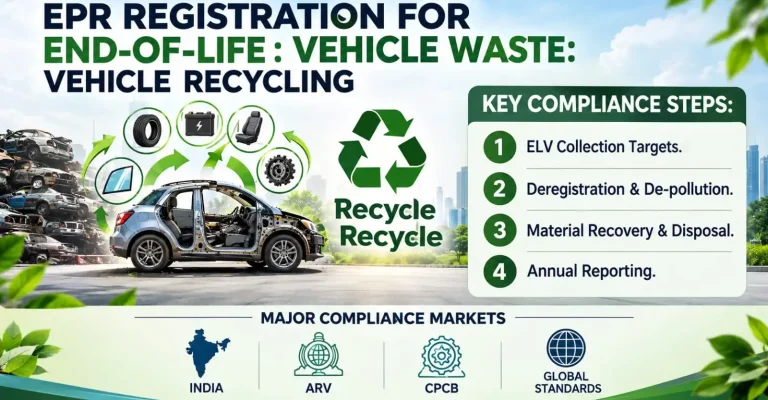
Falcon Can Help You Out
Falcon is a leading CHA and freight forwarding company with branches everywhere in India. We can help you import your products from other countries to India. We offer sea freight and air freight for imports.
Although filing for EPR is a simple process, the documentation makes it a complex procedure. We have a team of experts who can cater to your documentation needs. You just need to tell us the product, and we will inform you about the documents required. Our professionals can help you complete the required documents and fulfil the EPR obligations. We give support and guidance throughout the documentation process.
With 35+ years of experience, Falcon has a highly knowledgeable and experienced team. So, if you need help with either your BIS Registration or WPC approval, we are here for you. From covering your certificate requirements to warehousing and transportation, Falcon provides the best logistics services to help you expand your business.
For any queries on your EPR Registration for End-of-Life Vehicle Waste, you just need to connect with us at +91 93115 95648 or email us at cargodeal@falconfreight.com.
Conclusion
The Indian government has made EPR Registration for ELV Waste mandatory to support its Clean India, Green India initiative. It recently added ELV Waste registration to the CPCB portal to address the growing demand for vehicles. This helps the government maintain a safer, cleaner environment and focus on bigger issues beyond the waste management system. Manufacturers, importers, bulk consumers, and RVSFs are now responsible for the waste. In case of non-compliance, your company can face certain penalties and fines.
Therefore, it’s better to keep your documents ready and register them timely on the CPCB portal. Let us help you with that. Falcon has top in-office experts who can complete your documentation in minutes. Our professionals will keep you in the loop throughout the documentation and support you during your import journey. We also inform our clients about government updates and remind them about the renewals of their certificates. Connect today with our professionals at +91 93115 95648 or email us at cargodeal@falconfreight.com.