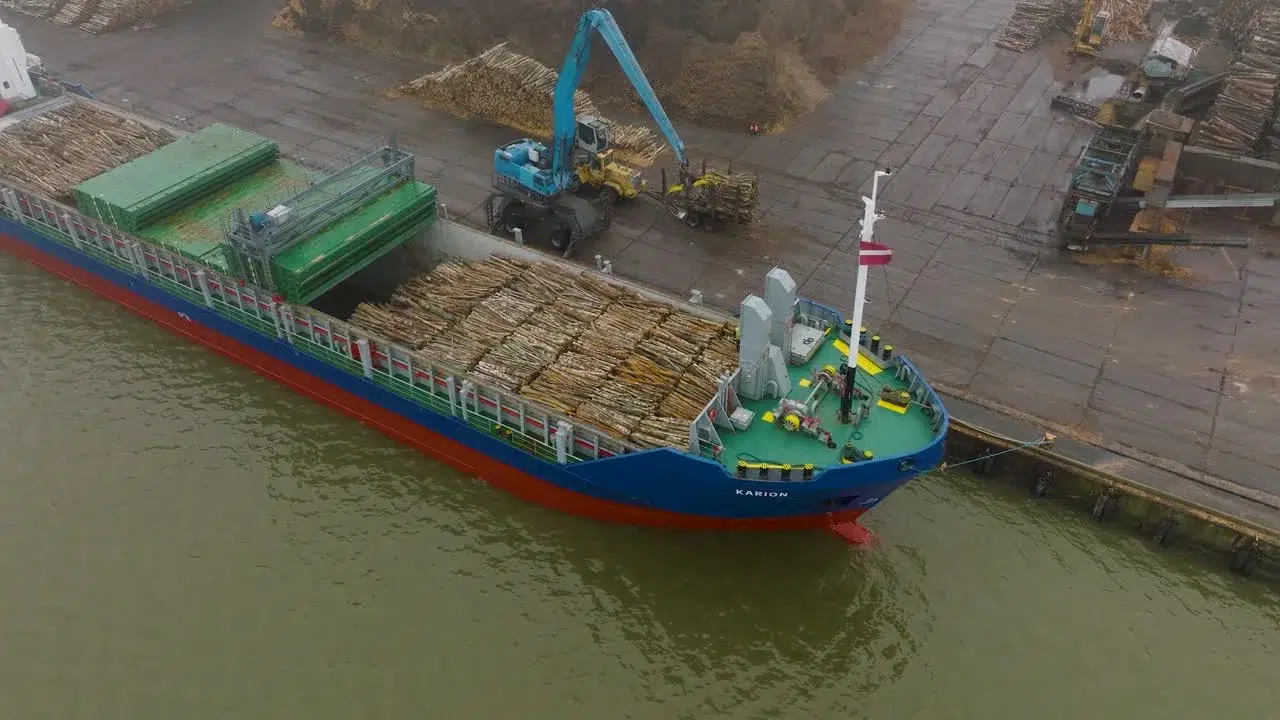
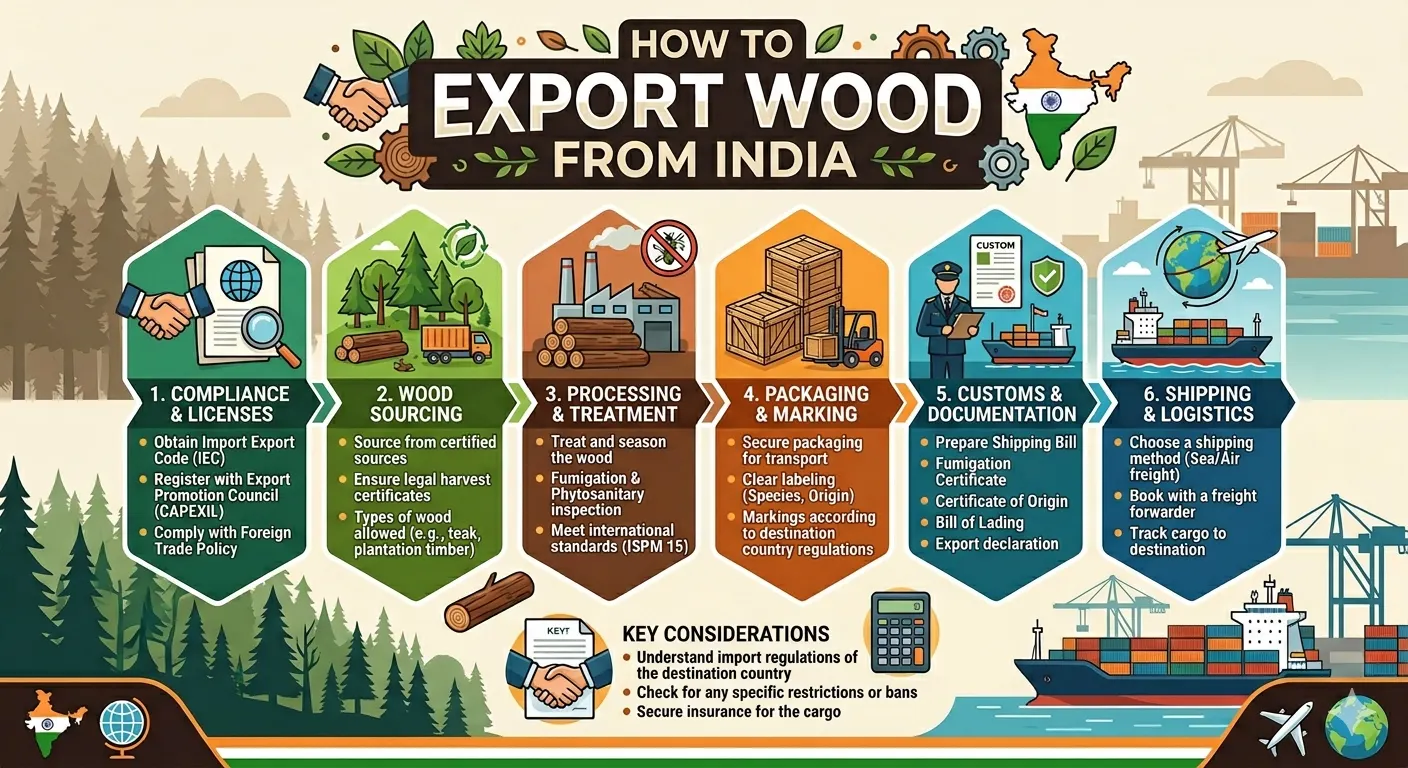
How to Export wood from India: When the question is put up, “How to Export wood from India”,– Well, the right way to answer the question “How to Export wood from India” is :
- Get in touch with genuine buyers and know the buyer’s demand.
- Then promote the timber/ wood and its products at global trade exhibitions.
- One can reach an international audience online or offline.
Wood exporters from India can create competitive analysis reports on exporters, ports, suppliers, and importers with the help of wood export data.
- In addition to this, here are the basic documents necessary for a triumphant wood export from India:
- Commercial invoice
- Certificate of origin
- Export license
- Bill of lading
- Shipping bill
- Phytosanitary certificate
- No objection certificate (NOC)
- Letter of credit
India has rich forest resources and diverse woodland areas. This includes tropical, hardwood forests, coniferous forests, deciduous and evergreen forests.
This growth is due to the growing demand for wood. It is propelled by the expansion of wood-reliant sectors like construction, paper, and packaging. Wood exporters in India provide a variety of products, including Acacia, Sandalwood, Teak, Bamboo, Timber, Mango, and Sheesham.
- Mundra port, Nhava Sheva port, Kandla port, Chennai Port, Vishakhapatnam Port and Cochin port are some of India ‘s major export ports.
Wood export regulations under the Foreign Trade Policy (FTP) divide wood products into “Free,” “Restricted,” or “Prohibited” categories. A majority of wood products need an IEC, RCMC, and specific documentation (e.g., Certificate of Origin, CITES permit).
Falcon 18 ( provides logistics support, including licensed customs clearance, sea/air freight forwarding, and specialized documentation for timber products.)
For more information:
Phone No. :- +91 9311595648.
Email :- cargodeal@falconfreight.com
Wood Export Rules In India & DGFT
Wood Export Rules In India & DGFT go hand- in- hand for rules and regulations. Well, the right way to answer the question “How to Export wood from India” is :
- Get in touch with genuine buyers and know the buyer’s demand. Then promote the timber/ wood and its products at global trade exhibitions. One can reach an international audience online or offline.
- United States, United Arab Emirates, United Kingdom, Saudi Arabia, Nepal, Bangladesh, Kenya, Nigeria, Netherlands are the biggest markets for wood export from India. Mundra port, Nhava Sheva port, Kandla port, Chennai Port, Vishakhapatnam Port and Cochin port are some of India ‘s major export ports.
- Here, in this case, exports require specific authorization. The exporter has to submit a Certificate of Origin from the Principal Chief Conservator of Forests (PCCF). Verification of legal sourcing, along with physical verification stock report take place. Then one can obtain an export license. A seller should seek DGFT authorisation to export a majority of raw wood, logs and timber.
The state PCCF issues the Certificate of Origin. It also gives details of stock quantities and legal confirmation. PCCF certifies the physical verification of the stock quantity. The exporter requires a Phyto sanitary certificate to meet the international standards. In the cases of Red Sanders and Sandalwood, there are specific wood restrictions.
Red sanders’ export is possible when the wood is sourced from cultivated land and not from the forest. Its origin and quantity require strict documentation. The government restricts sandalwood export however allows when they use it for value- added handicrafts.
Falcon 18 ( provides logistics support, including licensed customs clearance, sea/air freight forwarding, and specialized documentation for timber products.)
For more information:
Phone No. :- +91 9311595648.
Email :- cargodeal@falconfreight.com
If wanted to know more about export shipping from India then click on the link below ⬇
https://falconfreight.com/how-to-export-green-chillies-from-india/”
”https://falconfreight.com/how-to-export-fruits-and-vegetables-from-india/
https://falconfreight.com/how-to-export-green-chillies-from-india/”
”https://falconfreight.com/how-to-export-fruits-and-vegetables-from-india/
Handicraft Wood Export from India values at more than US$240 million in the first quarter of 2026. The USA, UK, and Germany import a great deal of handicrafts from India. Well, the right way to answer the question “How to Export wood from India” is :
- Get in touch with genuine buyers and learn and know the buyer’s demand. Then promote your timber/ wood and its products at global trade exhibitions.
- You can reach an international audience online or offline.
- Wood Export Rules In India & DGFT go hand- in- hand for rules and regulations. Mundra port, Nhava Sheva port, Kandla port, Chennai Port, Vishakhapatnam Port and Cochin port are some of India ‘s major export ports. The crucial products are furniture, kitchenware, and decor crafted from Sheesham, mango, and acacia wood. Saharanpur is the main source hub. . IEC, commercial invoice, and Packing List are the list of documents necessary for export.
- Carved furniture, kitchenware/tableware, like serving trays, bowls etc, candle holders, photo frames, and wall décor are some of the export items. Primarily mango wood, sheesham (Indian rosewood), acacia, teak, and eco-friendly reclaimed wood are the materials for export utility. Saharanpur
- (Uttar Pradesh) is the main source of red sanders and sandalwood, followed by Jodhpur and Moradabad. IEC (Importer-Exporter Code) from DGFT, commercial invoice, packing list, bill of lading, and certificate of origin are the basic and mandatory documents for export purposes.
- Falcon 18 is a leading provider of import-export consultancy, customs clearing, and freight forwarding services. The company specializes in, cargo consolidation, and logistics, particularly for shipments between China (Guangzhou) and India.
For more information:
Phone No. :- +91 9311595648.
- Email :- cargodeal@falconfreight.com
Fumigation Certificate in the Export Process
A fumigation certificate in the export process from India is a mandatory document for exporting agricultural products and wooden packaging (under ISPM-15) to prevent pests and infestation by other micro- organisms. Directorate of Plant Protection, Quarantine & Storage (DPPQS) issues this certificate for export purposes. The approved agencies treat cargo with approved fumigants like Methyl Bromide. This process takes 24–48 hours. The costs range from ₹1,000–₹5,000 per container.
Well, the right way to answer the question “How to Export wood from India” is :
- Get in touch with genuine buyers and know the buyer’s demand. Then promote the timber/ wood and its products at global trade exhibitions. One can reach an international audience online or offline.
- Wood Export Rules In India & DGFT go hand- in- hand for rules and regulations. Handicraft Wood Export from India values at more than US$240 million in the first quarter of 2026. Mundra port, Nhava Sheva port, Kandla port, Chennai Port, Vishakhapatnam Port and Cochin port are some of India ‘s major export ports.
- When exporting goods across borders, it is necessary that they are safe and secure. This certificate is mandatory for international trade as a majority of western countries worldwide, for instance, the United States, European Union, Australia, and New Zealand, follow strict biosecurity legislation.
- This is aligned to global standards such as ISPM 15. In other words, it is specific to wood packaging materials. The licensed fumigation agencies registered with the Directorate of Plant Protection, Quarantine & Storage (DPPQS) do the fumigation.
- Falcon 18 (p) Ltd assists in preparing, verifying, and managing all required export documents, a crucial step for international shipping to ensure compliance. For more information:
- Phone No. :- +91 9311595648.
- Email :- cargodeal@falconfreight.com
Cargo Fumigation & Documentation
1. Gas fumigation:
Fumigants in gaseous states for pest control. Enclosure of space with a gas-proof covering
- Methyl bromide – Effective for rodents, termites, insects etc
- Sulfuryl fluoride – Application on pests in grains, tree nuts etc.
2. Solid fumigation:
Solid fumigants – Effective against insect control in the form of tablets, powders etc. These are easier to use and safer than gaseous fumigants. Moreover these are less harmful to the environment.
Aluminium phosphide – all insect – pest control in flour, tea, doffer, cotton and grain.
Calcium cyanide – reacts with water vapour to form hydrogen cyanide. It eliminates a wide range of pests.
3. Liquid fumigants are effective against pests and insects.
They disperse large quantities of liquid over an affected area. Liquid fumigants are toxic to humans, and flammable. They are safest when performed outdoors. Eg: carbon disulfide, ethyl acetate, chloroform, carbon tetrachloride, and methyl bromide.
- Documents for wood export from India:
- Commercial invoice: It is a mandatory legal document for global trade. It acts as a contract and proof of sale between the buyer and seller.
- Certificate of origin: It is an international trade document. It certifies that goods in a shipment are obtained in a particular country.
- Export license: is a government-issued document to permit the legal export of goods to foreign destinations.
- Bill of lading: It is a vital legal document. This bill is issued by a carrier to a shipper. It serves as a goods receipt.
- Phytosanitary certificate: It is an official document issued by a country’s National Plant Protection Organization (NPPO). This verifies that plants / plant products meet the importing country’s health standards.
Conclusion
Export of wood from India is a hugely lucrative and developing industry. Its exports reached USD 623 million in 2022–23. It is led by strong international demand for teak, handicrafts, and furniture, hugely to the US, Germany, and the Netherlands. It requires concentration on sustainable development, quality standards, and digital marketing to highlight artisan craftsmanship. The industry is growing from enhanced global demand for handmade handicrafts and improvements in logistics and trade policies.
Falcon 18 assists in preparing, verifying, and managing all required export documents. It is taking a crucial step for international shipping to ensure compliance. For more information:
Phone No. :- +91 9311595648.
Email :- cargodeal@falconfreight.com