+91 9311595648

[email protected]

Enquire Now

[falcon_news_ticker]

Certificates for Food and Agricultural Products​

Certificates for Food and Agricultural Products

When trading certain food products, the importing country needs several certificates for food and agricultural products. This helps ensure they meet the importing country’s hygiene and safety standards. Many international markets have mandated these documents to avoid any pests and diseases. Moreover, they ensure consumers’ safety by meeting hygiene standards. In addition, these documents help prevent commercial risks for the exporter and avoid rejection upon arrival. Therefore, exporters require certain product-related certificates for food and agricultural products to avoid any future consequences.

However, knowing which certificate is right for your shipment can be tricky. This article covers all the types of certificates required for exporting food and agricultural products. It will help you understand the differences between the certificates and which one is best suited to your shipment.
 
You can also contact our team at +91-9311595648 or email [email protected] to learn more about these certificates.

Health Certificate for Food and Agricultural Exports

The EIC or APEDA issues the health certificate, confirming that the products in the shipment meet the safety and hygiene standards of the importing country. The authorities issue this certificate on a consignment-by-consignment basis. Therefore, it is valid for a maximum of 90 days. Major countries like the European Union, the USA, Japan, GCC nations and others more strictly require a health certificate from the EIC. On the other hand, other nations also require a health certificate but do not mandate the EIC-issued certificate.

A health certificate officially declares that the food was processed in an approved, hygienic facility. Additionally, it confirms that the products are free from prohibited additives and comply with the importing nation’s food safety laws. To learn more about the health certificate, visit our page: Health Certificate for Food and Agricultural Products↗️

Sanitary Certificate for Export

Quality officials at agencies like the EIC, APEDA, MPEDA, and FSSAI issue the sanitary certificate. Processed animal-origin foods and composite foods are the core scope of this certificate. It includes dairy, honey, egg products, seafood, certain agricultural commodities, and more. This certificate is used to verify food hygiene and human safety standards. Moreover, the primary focus of the inspection is factory hygiene (HACCP), pasteurisation, shelf-life, and lab tests for bacteria/antibiotics. As a result, the sanitary certificate confirms that the product has undergone the necessary inspections and tests and meets the importing country’s requirements.

A sanitary certificate has a strict validity period of 7 to 30 days before export. This is because biological and food products can become contaminated and decay. In addition, this certificate covers one specific shipment. Therefore, if you export these products regularly, you may need to obtain a sanitary certificate for each shipment. Similarly, exporters must obtain the certificate before the shipment leaves India.

Additionally, the sanitary health certificate is an umbrella category that includes the veterinary certificate, phytosanitary certificate, and more. As a result, it includes several tests, such as microbial testing, chemical residue testing, heavy metal testing, physical inspection, temperature verification, and more.

Veterinary Health Certificate

A veterinary health certificate is a sub-category under the Sanitary Certificate for exporting food and agricultural products. It ensures disease prevention, food safety, and traceability of animals and animal-based products. Categories covered under the veterinary health certificate are live animals, meat and meat products, dairy products, fishery and aquatic products, eggs and egg products, and animal by-products.

However, exporters have to go through a two-tier issuing process to obtain a veterinary health certificate.

  1. Initial Examination (Private Vet)
  2. Official Issuance & Endorsement (Government Authority)
Animal Quarantine and Certification Service is the government authority responsible for issuing this certificate. The AQCS works under the Department of Animal Husbandry and Dairying. Therefore, you must obtain a health certificate from the local vet before booking an inspection from the AQCS. The VHC confirms an animal or animal product meets the health and import requirements of the destination country. Moreover, the certificate follows a strict validity timeline, around 5 to 14 days, depending on the destination country and the animal species.
Similarly, an animal quarantine certificate is used to export animals and animal-based products. Click here to learn more about animal quarantine certificates.

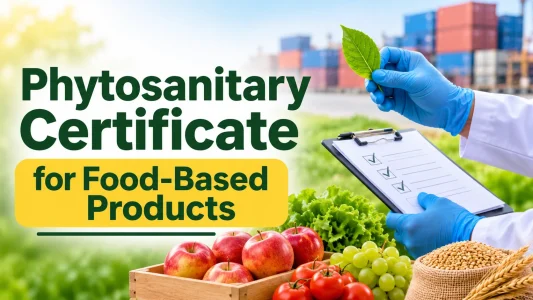
Phytosanitary Certificate for Food-Based Products
Phytosanitary Certificate for Food-Based Products ​

A phytosanitary certificate is issued for exports of fresh fruits, vegetables, seeds, cereals, plants, flowers, and plant materials. In India, the Directorate of Plant Protection, Quarantine and Storage issues the phytosanitary certificate under the Ministry of Agriculture and Farmers Welfare. It verifies that the products have been inspected and are free from pests and diseases. Hence, this is an important document for exporting plant-related products from India. Moreover, this certificate is typically valid for 14 days from the day of issuance. Without this certificate, the shipment may face inspection delays, rejection, quarantine, or even re-export at the destination.

Visit the Phytosanitary Certificate for Food and Agricultural Products page to learn more about this certificate.

Certificate of Analysis

A certificate of analysis is an official laboratory document that verifies a product’s quality specifications and test results before export. Several competent laboratories issue this certificate in India. These agencies include NABL-accredited laboratories, FSSAI-notified laboratories, government laboratories, and more. The certificate of analysis confirms whether the products meet the required quality, purity, composition, and technical standards as mentioned by the importing country. Additionally, it establishes traceability by linking a product’s batch to its test results.

This certificate is applicable to pharmaceuticals, cosmetics, chemicals, and food and agricultural products. Therefore, several parameters are checked before issuing the certificate of analysis. For example, pesticide residues, microbial contamination, fat content, freshness parameters, potency, composition, etc. However, this is not mandatory, as not all countries require it. Hence, you must check the importing country’s guidelines before obtaining the certificate of analysis.

Fumigation Certificate

A fumigation certificate is a mandatory, official document confirming that the cargo and wooden packaging have been chemically treated against pests and other diseases. The DPPQS-accredited private or authorised treatment agency issues the fumigation certificate in India. The certificate is valid for 21 to 30 days post-treatment. However, its validity depends on the importing country’s guidelines. Furthermore, the DPPQS issues the certificate based on the packaging material. For example, ISPM 15 is used for wood packaging. Similarly, for wooden packaginf, Methyl bromide (MB) fumigation, heat treatment, and more are also used. In contrast, if the cargo uses plastic or other packaging, these treatments are not applicable.

Visit our Fumigation Certificate page to know more about this.

Quality Inspection Certificate

A Quality Inspection Certificate verifies that goods meet the required quality, safety, and technical standards before shipment or delivery. It confirms that an authorised inspection agency has examined the products. Moreover, it confirms that the products comply with the buyer’s specifications or applicable regulations. The inspection may cover product quantity, weight, dimensions, packaging, labelling, and quality parameters.

In addition, exporters need this certificate as proof for the importing country that requires verification of product quality. As a result, the inspection body carries out physical inspection, laboratory testing or sample analysis. Therefore, a quality inspection certificate builds buyer confidence and helps reduce the risk of disputes, rejection, or delays.
Organic Certificate
An Organic Certificate verifies that agricultural products have been processed, produced, and handled according to organic farming standards. Moreover, it confirms that the producer or exporter follows approved practices and meets the requirements of the destination country’s organic certification system.

In India, exporters must comply with the National Programme for Organic Production, under APEDA, for organic exports. Furthermore, authorised certification bodies inspect farms, processing facilities, and supply chains to verify safety standards. The certificate helps exporters establish the organic status of products and access international organic markets. However, exporters must also meet the importing country’s specific organic certification and labelling requirements.
Country of Origin Certificate

A Certificate of Origin (CoO) is an official document that identifies the country where exported goods were produced, manufactured, or transformed. As a result, it helps the importing country determine the origin of goods and apply the appropriate customs duties and trade regulations. In India, authorised agencies issue Certificates of Origin through the designated certification system.

Therefore, exporters use this certificate to claim preferential tariff benefits under Free Trade Agreements. There are two main types:

  1. Firstly, the Preferential Certificate of Origin. It supports reduced or zero customs duties under trade agreements.
  2. Secondly, there is the Non-Preferential Certificate of Origin. It establishes the origin of goods without claiming preferential tariff benefits.
If you want to learn more about the country of origin certificate, click here↗️
Conclusion

While exporting food products, all the documents are product-specific. As a result, there are different types of certificates for food and agricultural products. Therefore, selecting the wrong document can lead to delays and rejection of your shipment. To avoid these issues, you need an experienced professional to help you identify the required documents. Moreover, an expert can help you understand the other formalities required to meet your export needs. But don’t worry, Falcon is here to help you. We have a team of dedicated documentation experts to help businesses complete their documentation requirements.

At Falcon, we help businesses expand their presence throughout the world. From documentation to freight forwarding, customs clearance, and more, we handle everything your business needs. Our team assists with your shipment requirements and complies with regulatory authorities to smooth your trading journey. Contact our team today at +91-9311595648 or email [email protected] for your trading queries.
Scroll to Top