Enquire Now
Latest News
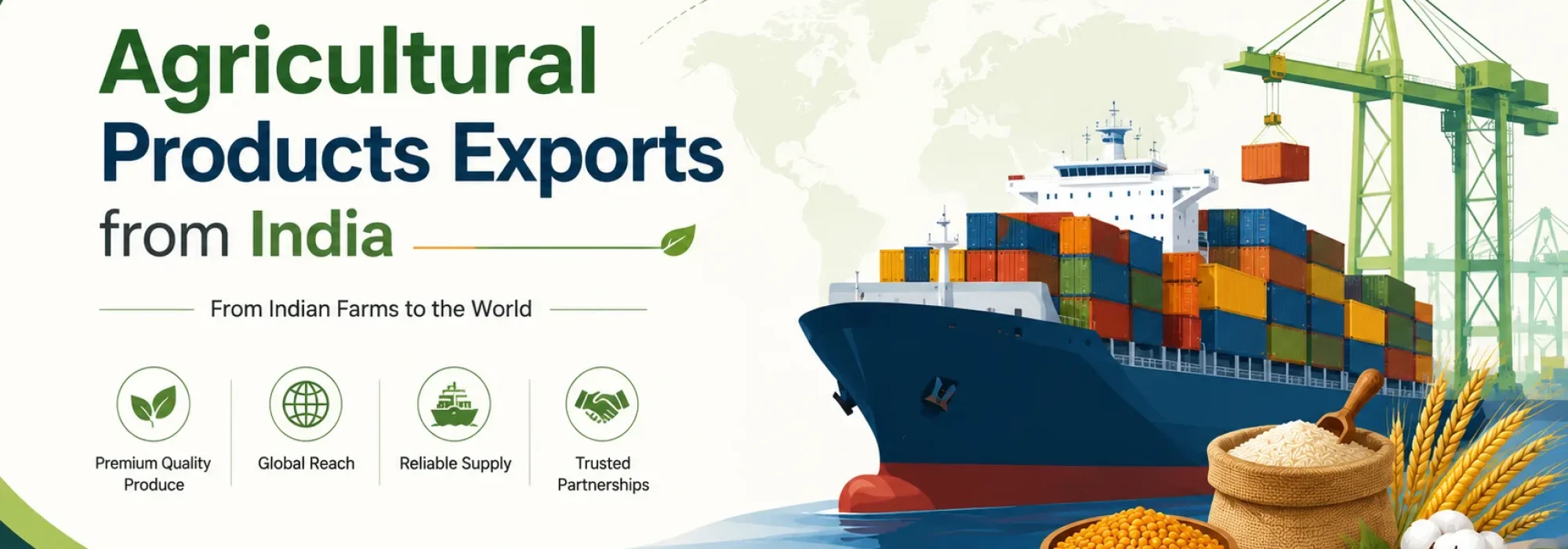
Agricultural Products Exports from India

Agricultural Products Exports from India

India’s growing presence in Agricultural Products Exports from India reflects the country’s strong agricultural production and increasing demand from international markets. India exports a diverse range of agricultural commodities to markets across the world, supported by its strong agricultural production, established supply chains, and growing global demand.

Key highlights of India’s agricultural exports include:

  • Wide range of commodities: India exports basmati and non-basmati rice, spices, raw cotton, castor oil, sugar, coffee, tea, fruits, vegetables, and other agricultural products.
  • Strong export value: Agricultural exports from India contribute significantly to the country’s international trade, reaching over $51 billion.
  • Major export ports: Mundra Port, Nhava Sheva Port, Kandla Port, Chennai Port, Visakhapatnam Port, and Cochin Port are among the major gateways handling agricultural exports.
  • Key spice markets: Indian spices have strong demand in the United States, China, the United Arab Emirates, Bangladesh, and Saudi Arabia.
  • Other international buyers: The United Kingdom, Thailand, Malaysia, Indonesia, and Germany are also important markets for Indian agricultural products.
  • Global market opportunities: India’s diverse agricultural production and expanding international demand create significant opportunities for exporters across multiple commodity segments.

Together, these factors make India an important supplier of agricultural products to global markets, with opportunities continuing to expand across both traditional and emerging destinations.

You can also check our product export pages below to learn more about the agricultural products we export from India.

Export fruits and vegetables↗️
Export Spices from India↗️
Export Rice from India↗️

Top Export Categories of Agricultural Products

India exports a diverse range of agricultural products to markets across the world. Some of the key export categories include:

Rice: Basmati and non-basmati rice account for a significant share of India’s agricultural exports. Indian rice is widely shipped to markets in the Middle East, Africa, Asia, Europe, and the United States.

Spices: India is known for exporting turmeric, cumin, chilli, black pepper, coriander, cardamom, and ginger. These spices are used by food manufacturers, wholesalers, restaurants, and retailers worldwide.

Sugar: Sugar is an important agricultural commodity exported from India, with shipments varying according to production levels, domestic demand, and government policies.

Cotton: Raw cotton is exported to international textile markets, where it is processed into yarn, fabric, and finished garments.

Oilseeds and Oils: Groundnuts, sesame seeds, and castor oil are among the products exported for use in food processing and various industrial applications.

Coffee and Tea: Indian coffee and tea have established international markets. Assam, Darjeeling, and Nilgiri teas, along with coffee from southern India, are valued for their distinctive characteristics.

Fresh Fruits and Vegetables: Products such as mangoes, grapes, pomegranates, onions, and other fresh produce are exported to international buyers. These shipments require careful handling and suitable temperature management.

Falcon helps exporters move agricultural products from India through customised multimodal transportation solutions, including sea, air and road. Temperature-controlled containers and IoT tracking can support the safe and efficient movement of sensitive cargo.

For more information:
Phone: +91 9311595648
Email: cargodeal@falconfreight.com

Reliable Agricultural Products Exporters in India

India has a large and diverse agricultural export sector, with exporters specialising in fresh produce, spices, grains, rice, and processed food products. Kay Bee Exports for fresh fruits and vegetables, NK Agro for spice extracts, and multi-commodity suppliers like Weltweit Agri-Exports and Yuvaraju Agro Impex are some of the reliable agricultural product exporters in India. In other words, they specialise in rice, spices, fresh produce, and processed foods.

Top Exporters & Specialisations

  • Kay Bee Exports: A leading exporter of fresh fruits such as pomegranates, mangoes, and grapes, as well as vegetables, with a focus on global compliance standards.
  • NK Agro: Specialises in spices, oleoresins, and natural food-colouring extracts.
  • Weltweit Agri-Exports: Supplies grains, basmati and non-basmati rice, peanuts, sugar, and spices.
  • Yuvaraju Agro Impex: Offers rice varieties such as Sona Masoori and Basmati, along with pulses and fresh produce.
  • Field to Feed Exports: Trades in dehydrated products, superfoods, and herbs, with a focus on farm-to-port traceability.

Key Export Categories

  • Cereals & Grains: Basmati and non-basmati rice, wheat, and maize are the main cereals and grains.
  • Spices: Cumin, turmeric, chilli powder, and pepper are among the major spices.
  • Fresh Produce: Mangoes, bananas, pomegranates, and onions are some of the fresh fruits and vegetables exported from India.
  • Processed Foods: Jaggery, oilseeds, and ready-to-eat items are among the commonly exported processed food products.

Key export commodities such as basmati and non-basmati rice, spices (including turmeric, cumin, and chilli), raw cotton, castor oil, sugar, coffee, and tea contribute significantly to India’s agricultural exports. Mundra Port, Nhava Sheva Port, Kandla Port, Chennai Port, Visakhapatnam Port, and Cochin Port are some of India’s major export ports.

Falcon Freight handles regulatory export paperwork, customs clearance, and government compliance, helping exporters manage the documentation and formalities involved in international agricultural shipments.

Documents Required for Exporting Agricultural Products from India

The required documents may vary depending on the product and destination country. Key documents commonly required include:

  • Phytosanitary Certificate – Confirms compliance with plant-health requirements.
  • Certificate of Origin – Verifies the country of origin of the goods.
  • Health Certificate – Required for certain food and agricultural products.
  • Fumigation Certificate – Required for applicable agricultural commodities.
  • Inspection Certificate – Confirms required quality or safety standards.
  • Commercial Invoice & Packing List – Provides shipment, product, quantity, and value details.

Requirements can differ by product and destination. For more information on the documents required for export, you can visit our page here↪️

Conclusion
India’s agricultural sector remains a cornerstone of national food security and economic stability. In essence, it achieves record foodgrain and horticulture output alongside rising processed food exports. Along the same lines, continued investment in value addition, sustainable farming, and export diversification are vital to secure long-term global competitiveness.
 
Falcon Freight monitors IoT tracking devices on cargo during the entire global journey.
 
For more information:
Phone No:- +91 9311595648.

Check the Latest News and Updates Here

Mundra Strikes- September 2026

MUNDRA STRIKES – SEPTEMBER 2026

Mundra Strikes- September 2026 On September 1st, Adani Ports and Special Economic Zone (APSEZ) introduced a new system that requires all empty containers to be handled inside the Mundra SEZ. This decision triggered the biggest Mundra Strikes of September 2026. This decision caused chaos at the port, as off-site empty-container depots, transporters, and shipping lines

Read More »
India Chile Announce New Trade Partnership Initiatives

India Chile Announce New Trade Partnership Initiatives

India Chile Announce New Trade Partnership Initiatives Having reached $6.25 billion in the 2025-26 Fiscal Year, India Chile Announce New Trade Partnership Initiatives as talks advance to upgrade India-Chile trade ties into a Comprehensive Economic Partnership Agreement (CEPA). Henceforth, India is looking to secure stable supply chains and preferential access to essential minerals like copper,

Read More »
Reduction of Import Duty on Aluminium Scrap

Reduction of Import Duty on Aluminium Scrap

Reduction of Import Duty on Aluminium Scrap India’s Ministry of Mines has proposed the elimination of the aluminium scrap duty, recommending a reduction of import duty on aluminium scrap, including the removal of the existing duty, to help lower raw material costs for secondary aluminium producers and small businesses. The move could make imported scrap

Read More »