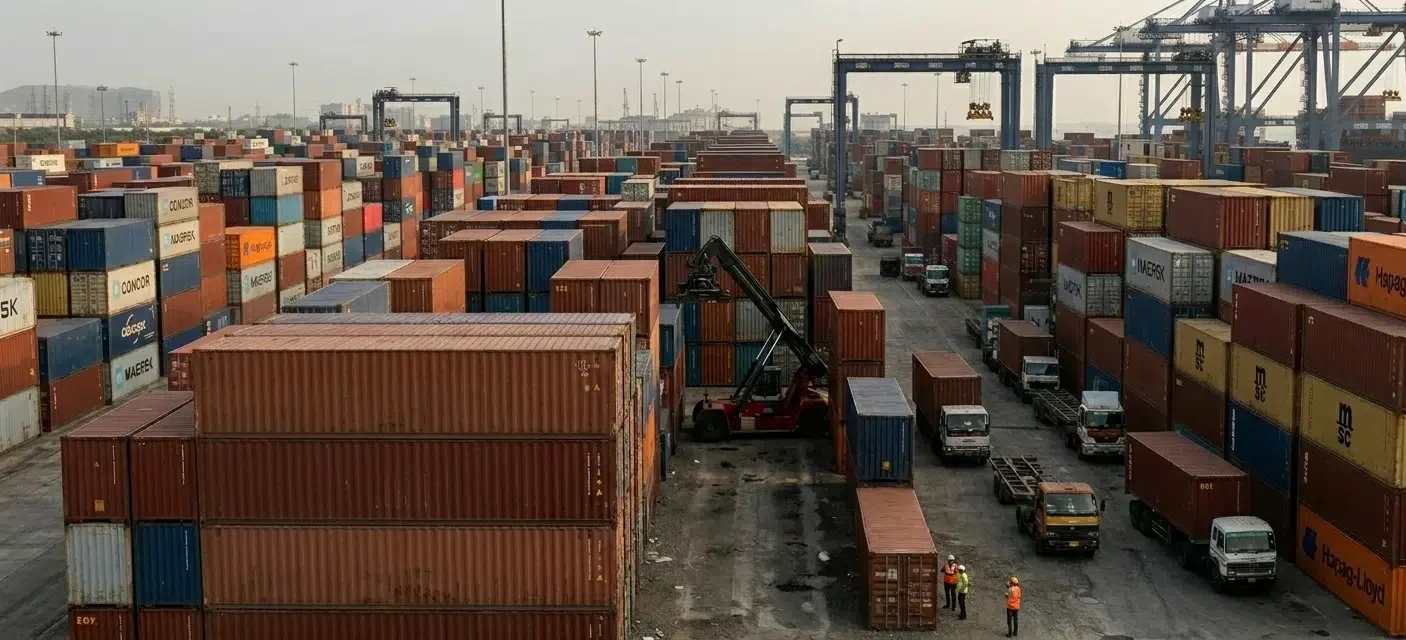
45000 Indian Containers stuck and Export costs increase five-fold at present due to the engulging war in the middle east. The war in West Asia is affecting the whole world’s economy at present. The logistics firms are suffering miserably with 40-45 thousand Indian containers left stranded in the middle of nowhere. They are left stranded in transit or at the international ports.
The future of $ 1-1.5 billion worth of export cargo is under the weather. They are contemplating a diversion in route or return to India due to conflicting surroundings. To make things worse, contingency surcharges are mounting due to the additional three- to – five fold increase in per container cost charged by the shipping liners.
Adding up, these 3 are leading to gigantic costs and container crisis. The perishable goods exporters are suffering lofty losses. If you believe in the sources, 4 lakh tonnes of basmati rice are stuck there. Cargo worth about $1-1.5 billion is stuck in the waters, for both air and sea routes. Mundra port, Nhava Sheva port, Kandla port, Chennai Port, Vishakhapatnam Port and Cochin port are some of India ‘s major export ports.
Falcon (Falcon Freight/Overseas) facilitates international trade through end-to-end logistics, specializing in customs clearance, air/sea freight consolidation, and sourcing services for exports and imports across India and global markets.
For more information:
Phone No. – +91 9311595648.
Email – cargodeal@falconfreight.com
India supply chain disruption of containers
India supply chain disruption of the containers is affecting every corner of the world. 45000 Indian Containers stuck and Export costs increase five-fold at present due to the engulging war in the middle east. Customers might have to discharge import containers at Khorfakkan Port or Fujairah Port.
DP World, in coordination with shipping lines is arranging for the containers to move on road transit to Jebel Ali Port for final clearance. A lot of such containers stuck could not be Indian, as they include many Non-Vessel Operating Common Carrier (NVOCC) operators, operating in the Persian Gulf region. NVOCCS might not be owning these ships, however they own these containers. India supply chain disruption of the containers is affecting every corner of the world.
However, a majority of the exporters are suffering also because of the additional $3,000-5,000 per container surcharge they have to pay. Floating cargo in the Arabian Sea also is a risk currently. French Shipping giant, CMA CGM, applied an emergency surcharge one day after tensions escalated in the Strait of Hormuz. This cost also levied a $2,000-4,000 surcharge on cargo. Later, almost all the other major shipping lines introduced the surcharges and added to the woes of the exporters. “There could be containers that are either at sea or near the neighbouring ports.
It is a compelling situation and if they are not having the possibility of discharging at the Gulf, they would discharge at ports like Salalah or return to India.

Global Shipping Crisis Impact India in a large way and truly speaking is impacting the whole world. 45000 Indian Containers stuck and Export costs increase five-fold at present due to the engulging war in the middle east. India supply chain disruption of the containers is affecting every corner of the world. Mundra port, Nhava Sheva port, Kandla port, Chennai Port, Vishakhapatnam Port and Cochin port are some of India ‘s major export ports.
Shipping lines are doing their best and trying to move to rerouting across transport modes to ensure cargo gets through timely. These are exceptional circumstances, and hence they cannot have normal charges. Containers will have to take a round route now, and hence freight rates for us have increased by 40 per cent from around 200 per kilogram to about 280 per kilogram.
Conclusion
These times when 40000–45,000 Indian containers stranded at Gulf ports due to the West Asia conflict, it represents a serious, emergency-like, and high-cost crisis for India’s export sector. At present around $1–1.5 billion worth of cargo—primarily basmati rice and perishables are at risk. The crisis has seen shipping costs shooting upto five times and prompting calls for government intervention in such an audacious situation. It is high time the government implemented ‘Back-to-Town‘ (BTT) procedures for returning goods and provide with waivers on port charges.
Exporters are suffering huge losses due to war-risk surcharges ($3,000–$5,000 per container) and spoiled cargo, particularly for perishable items.
Falcon (Falcon Freight/Overseas) optimizes supply chain management focusing on international trade. They enhance efficiency via swift customs clearing, multi-modal freight forwarding (air/sea/land), and secure warehousing, reducing costs and accelerating delivery.
For more information:
Phone No. :- +91 9311595648.
Email :- cargodeal@falconfreight.com