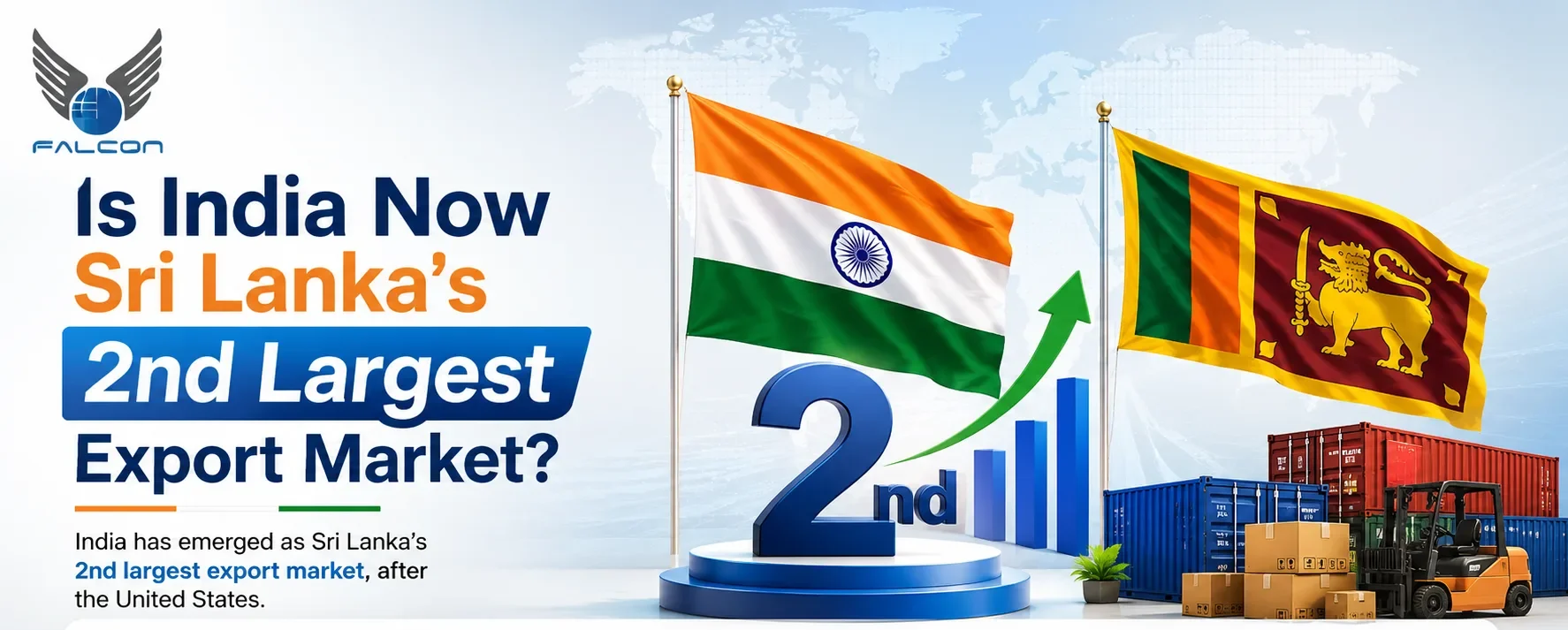
Is India Now Sri Lanka’s 2nd Largest Export Market? When someone asked recently, “Is India Now Sri Lanka’s 2nd Largest Export Market?”, the answer is in the positive with a reason to smile. Yes, the Sri Lanka Export Development Board (EDB) data revealed it. The top market indeed is the United States of America. In fact, the second largest is India, with shipments reaching \(\$364.15\) million (an 8.9% year-on-year growth). The third largest is The United Kingdom. Indeed, it saw a notable decline in exports from Sri Lanka.
The rising regional trade integration and growing demand for Sri Lankan coconut-based products is behind this shift. This shift happened between January and April this year. Merchandise and services brought about this shift. Coconut products and IT services performed extremely well. India has consolidated its position as Sri Lanka’s second-largest export destination. It has surpassed the United Kingdom now.
The total exports for January-April 2026 are estimated at USD 5,784.38 million. In other words, it reflects a growth of 4.3 per cent over the corresponding period in 2025.
Coconut-based products recorded a strong performance in April 2026. After this, the export earnings surged by 23.49 per cent year-on-year. Activated carbon registered a 58.32 per cent jump. Similarly, it reached USD 20.55 million in April 2026.
On the services front, information and communication technology and business process management exports reached USD 146.09 million. On top of this, the financial services exports expanded by 119.4 % to USD 6.82 million. The earnings decline from apparel and textiles by 4.88 per cent year-on-year to USD 346.67 million in April 2026, however is not a good sign. Moreover, it is due to the 2.7 % reduction in shipments to the United States.
Crucial Products Exported from Sri Lanka to India
The Crucial Products Exported from Sri Lanka to India are pepper and areca nuts, coconut products, services, and petroleum oils. Furthermore, these vital goods form the foundation of bilateral trade. These products facilitate under the Indo-Lanka Free Trade Agreement (ISFTA).
For Sri Lankan coconut products, India represents a rapidly growing market. In addition, a rising demand for value-added items fuels exports to India. Liquid coconut milk, UHT coconut cream, virgin coconut oil, and desiccated coconut are the major products. Most importantly, activated carbon (derived from coconut shells) and cocopeat/coir products are other major exports from Sri Lanka.
On top of this, liquid coconut milk is a versatile, dairy-free ingredient. It enhances a creamy texture to savoury curries, soups, and beverages. Likewise, it also serves as an excellent plant-based milk substitute. It is useful in baking, oatmeal and smoothies’ preparation. After this, it also nourishes the skin as cosmetic DIY masks. It adds a rich, flavour base for authentic Indian curries. It helps balance strong spices and chili heat. Moreover, it is a dairy-free cream replacement in stews.
Activated carbon from Sri Lanka to India has the HS Code 38021000. Importers benefit from concessions or zero basic customs duties under the India-Sri Lanka Free Trade Agreement. Furthermore, a valid Certificate of Origin is essential. The most common shipping route is ocean freight from the Port of Colombo to major Indian ports like Nhava Sheva (Mumbai), Chennai, or Cochin. Typically, this route takes transit times of 4 to 10 days.
Activated Carbon is useful in water purification, industrial pollution control, food and beverage processing, and gold recovery. In general, it is useful in municipal and household water filters. It adsorbs chlorine, heavy metals, volatile organic compounds (VOCs), and unpleasant tastes/odours.
Agricultural Exports Sri Lanka India
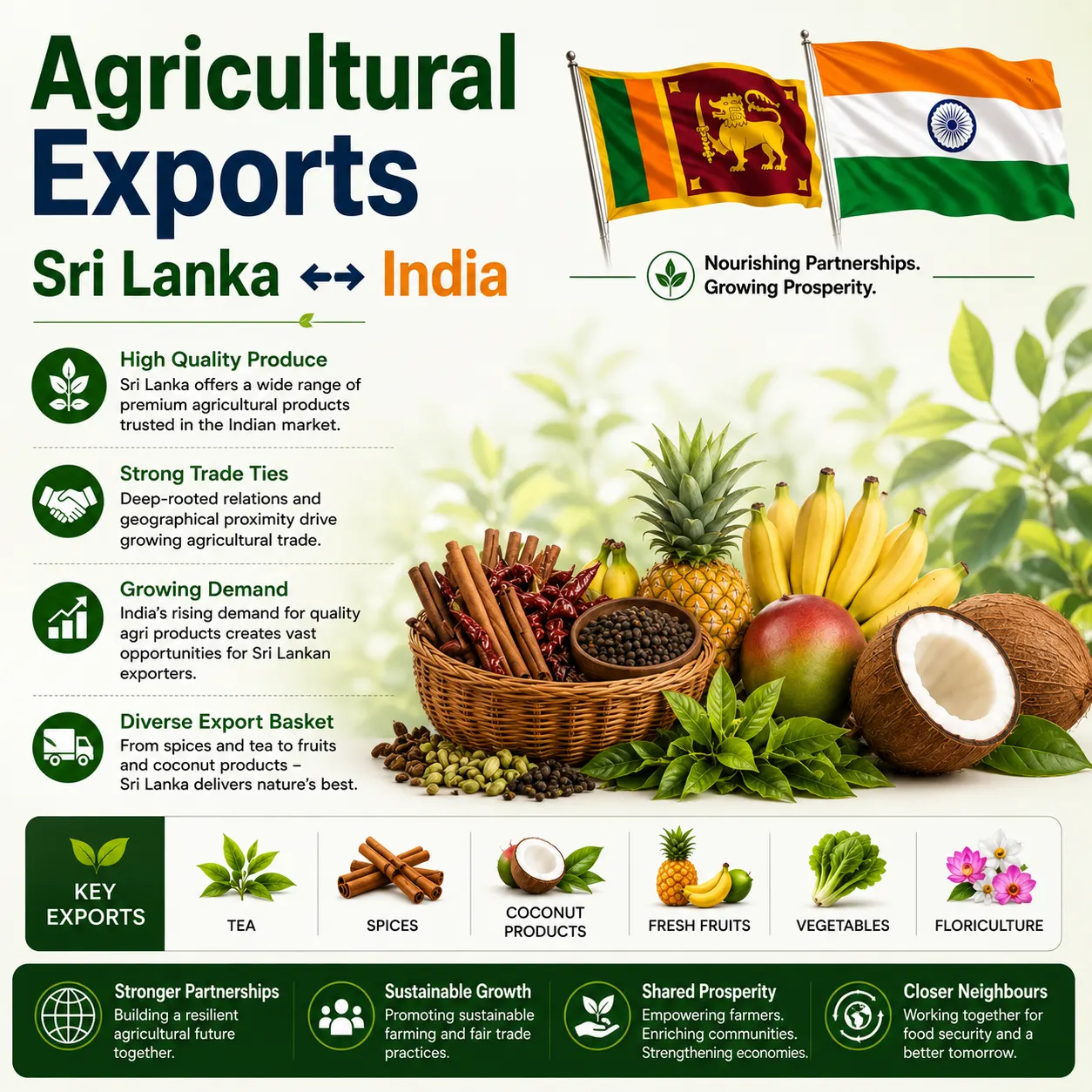
Agricultural Exports Sri Lanka to India is highly active. In fact, it is one of the fastest growing export destinations. Sri Lanka, generally, exports high-value cash crops and plantation commodities to India. Moreover, spices (specifically black pepper and cinnamon), and coffee are the main exports. In addition, edible nuts (like areca nuts), and vegetable/fruit preparations are in great demand.
Most of the wholly-obtained agricultural goods benefit from zero-duty access. These are under the India-Sri Lanka Free Trade Agreement (ISFTA). Most importantly, exports of black pepper from Sri Lanka to India requires navigating trade agreements and strict quality standards. Sri Lankan exporters rely on tariff concessions. On the other hand, Indian importers comply with a Minimum Import Price (MIP) and strict certification requirements. In fact, it is useful for re-exporting, oleoresin extraction, and blending. Imports are heavily regulated to protect domestic farmers while meeting industrial demand.
Exporting cinnamon from Sri Lanka to India requires compliance with strict customs regulations. In a nutshell, it has to secure preferential tariff benefits, and meet food safety standards. India is one of the world’s largest importers of cinnamon. Although, Vietnam is the main source of cassia cinnamon, Sri Lanka is the main exporter for premium “True” Ceylon Cinnamon.
On top of it, there is a consumer demand for premium flavour, medicinal use, and industrial applications. It is a premium, and sweeter flavouring agent in traditional Indian spice blends (garam masala), biryanis, teas, and bakery products.
Conclusion
India officially overtook the UK to become Sri Lanka’s second-largest export destination. In addition, it is run by increasing demand for coconut products, ICT services, and strategic regional economic ties. Moreover, this milestone waives a major shift in South Asian trade. Value-added coconut products (such as activated carbon) and IT services drive this bilateral agreement. Proximity to India provides Sri Lankan exporters significant and lower logistics costs.
With India emerging as Sri Lanka’s second-largest export destination, efficient cross-border logistics are vital. Falcon Freight facilitates this bilateral trade by offering great import/export consulting, effective customs clearance, and end-to-end logistics support. This ensures timely and compliant shipments across borders.
For more information:
Phone No. :- +91 9311595648.
Email :- cargodeal@falconfreight.com