Table of Contents
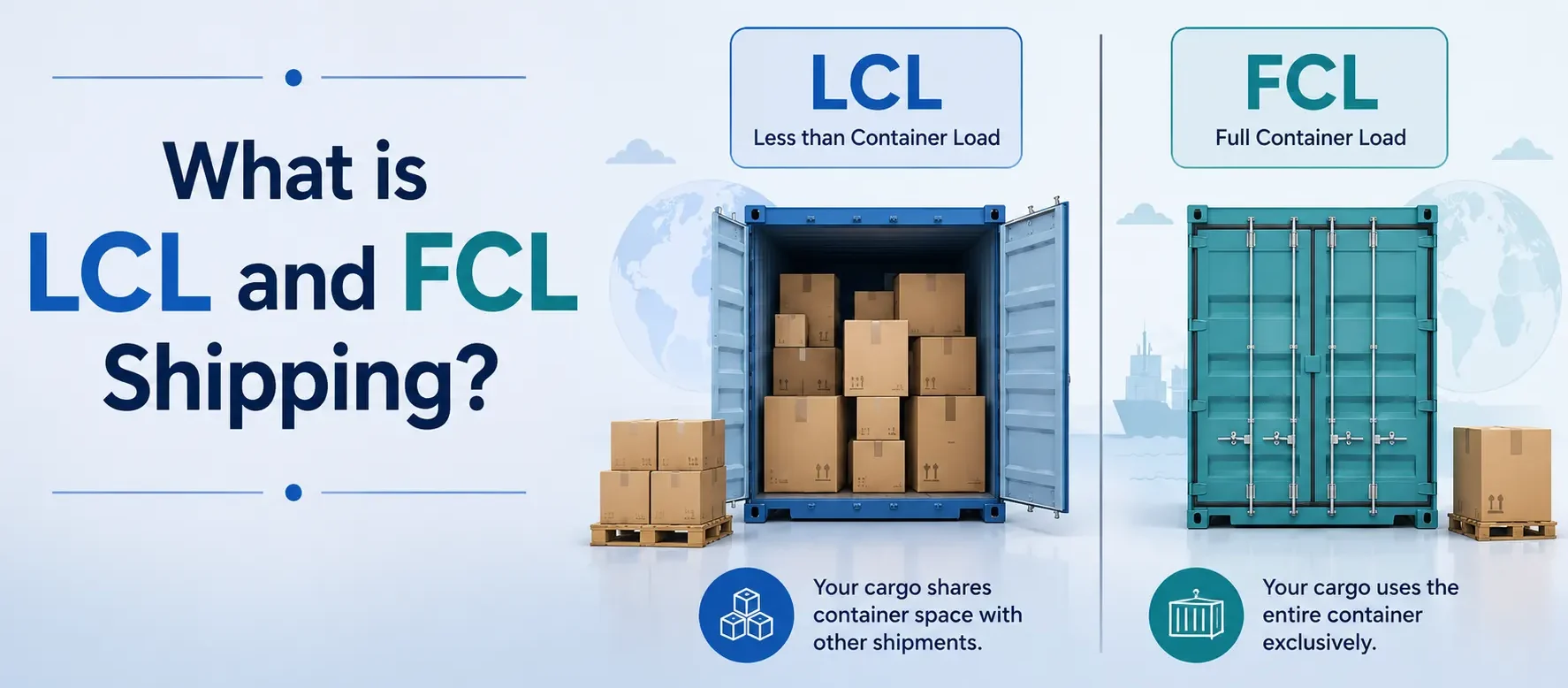
What is LCL and FCL shipping? How will you answer this question, “What is LCL and FCL shipping?” There are simple and basic facts to know when you answer the question. In fact, FCL (Full Container Load) finds its use when you are shipping high volumes (\(>13\) cubic meters). You get the lowest per-unit cost, faster transit, and maximum security. In addition, you rent an entire container solely for your own cargo. You pay a flat rate for the box, regardless of whether it is completely full or not.
Furthermore, LCL (Less than Container Load) is useful when you have smaller shipments. You also need to save on upfront costs. To sum it up, your goods share a container with cargo from other shippers. You only pay for the exact volume or weight you use. Likewise, the measurement will be in Cubic Meters (CBM). There is higher risk in LCL. Above all, there will be more handling and loading/unloading alongside other goods. While LCL looks economical, you have to pay extra destination fees. After this, if another shipper in your shared LCL container has a customs issue, it would delay your cargo too.
Falcon Freight assists with end-to-end logistics. Along with this, space consolidation, customs clearance, and inland transportation are expert areas of Falcon Freight.
Best Shipping Option for Small Cargo
The best shipping option for small cargo is LCL (Less than Container Load). On top of this, it is the best choice when you are shipping under 15 CBM. In this case, you only pay for the space used. Choose LCL when you have a small shipment, and are on a tight upfront budget.
Furthermore, you do not have to worry if your cargo is non-perishable and not highly fragile. How will you answer this question, “What is LCL and FCL shipping?” In addition, Mundra port, Nhava Sheva port, Kandla port, Chennai Port, Vishakhapatnam Port and Cochin port are some of India ‘s major export ports. The choice of grouped shipment (LCL) allows cost savings.
Moreover, if the goods do not fill a container (less than 15 cubic meters), it allows savings on storage. In LCL, loading/unloading operations (separating bulk) are higher in number. Thus, this could lead to damage, loss or theft of goods too. So, the clients in need of safe transport prefer using single containers (FCL).
FCL gets delivered more quickly than LCL. It is because, the customs and inspections procedures are more straightforward. Furthermore, it is one container worth of goods, rather than from several different suppliers. When an LCL shipment gets to a port, they consolidate different shipments.
Then, they match documents with each item in the container. This is why, LCL takes longer in sorting. They check every shipment. LCL has no guarantee of the other goods that are shipped in the same container. For instance, there may be corrosive, smelly or liquid goods. Therefore, there is a greater risk of damaging of your goods.
Falcon Freight streamlines operations by helping businesses optimize container space. They also help get cost-effective freight rates.
Conclusion
The choice between LCL (Less than Container Load) and FCL (Full Container Load) depends on your cargo volume, budget, and delivery deadline. In general, for shipments more than 15–18 CBM or when security and speed are priorities, choose FCL. For smaller, less time-sensitive cargo, LCL offers budget-friendly flexibility. Moreover, you use FCLwhenyou are shipping high volumes, handling fragile or high-value inventory. It is also useful while facing strict delivery deadlines. Furthermore, you use LCL when you are testing new markets. Moreover, you choose LCL when managing lower e-commerce volumes, or aiming to keep inventory low and turnover high.
Falcon Freight handles necessary import/export documentation and permits in key hubs like India, China, and the UAE.
For more information:
Phone No. :- +91 9311595648.
Email :- [email protected]