How Geopolitical Tensions Are Affecting Global Imports and Exports has become a key concern for businesses and policymakers in these uncertain times. India’s latest trade figures highlight both the challenges and resilience of global commerce. To begin with, India’s merchandise exports jumped 18% in May, rising to $45.20 billion despite ongoing geopolitical disruptions. On top of it, India expects better performance ahead following the truce in West Asia. Meanwhile, imports also surged by over 20% to reach $73.91 billion, reflecting strong trade activity despite global uncertainties.
Most importantly, India imported for about $60.86 billion in May 2025. It is because of a spike in energy prices and higher gold imports. In fact, India imports 88%. crude oil it processes. Above all, it meets 60% of its cooking gas consumption through imports. The whole world witnessed a spike in energy prices after the west Asia war broke out on 28 February 2026.
In addition, the situation further aggravated after the key transit point, the strait of Hormuz Closed. When the strait of Hormuz closed the movement of 20% global energy supplies halted. This in turn escalated the cost of fuel imports. Moreover, India’s petroleum imports surged by 53.8% on an annualised basis to $ 22.68 billion in May 2026.
If you want to know about documentation for import-export, click here↗️.
How did Exports rise in India?
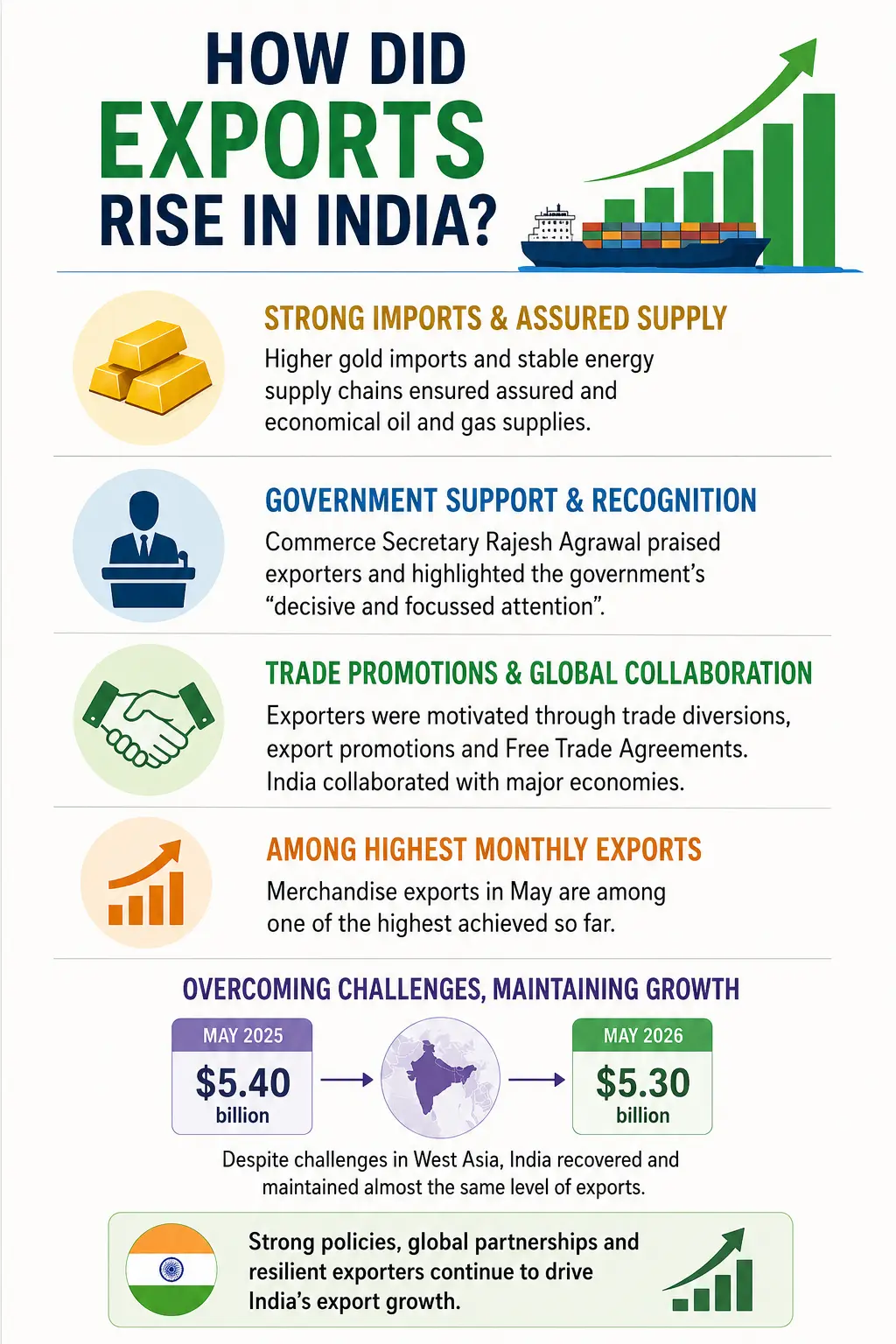
While answering the question, “How did Exports rise in India”, there are a number of significant reasons how it all happened. In a nutshell, India’s gold imports in May this year jumped to $3.42 billion as compared to $2.55 billion in May, 2025. On top of it, the prospects of a truce and re-establishment of energy supply Chain would help energy importers like India. Above all, this will help in terms of assured and economical supplies of oil and gas.
In other words, the prospects of a truce and re-establishment of energy supply Chain would help energy importers like India. This will help in terms of assured and economical supplies of oil and gas. Similarly, Rajesh Agrawal, Commerce Secretary praised that the Indian exporters performed well despite all odds. He also gave credit to the government’s “decisive and focussed attention”.
In conclusion, it motivated exporters to boost exports through trade diversions, export promotions and Free Trade Agreements. India worked in collaboration with major economies. Furthermore, the merchandise exports in May is among one of the highest monthly exports that we have achieved thus far. The conflict in West Asia impacted Indian exports in the region.
Slowly and gradually, Indian exporters learned to adjust to the situation and worked on expanding exports. In May 2025, India’s merchandise exports in the region were $5.40 billion. However, in May 2026, we made up for the losses and reached $ $5.30 billion. We successfully achieved more or less the same level of exports, in spite of the challenges.
What are the reasons behind rise in exports?
Well, it is a very good question keeping in mind the uncertainties and disruptions that gripped the whole world. Let us discuss some key factors. In conclusion, it motivated exporters to boost exports through trade diversions, export promotions and Free Trade Agreements. He also gave credit to the government’s “decisive and focussed attention”.
Likewise, we successfully achieved more or less the same level of exports, in spite of the challenges. Moreover, countries like the UAE with 3.2% annualised increase, KSA. (11%), Jordan (211%). Moreover, Syria (209%) and Yemen (16.5%) drove the exports growth. Despite challenges, supply chains remained entrenched.
Some of these countries saw a spike in Indian exports because the goods first landed there. Finally, Indian exporters are using – Duqm, Sohar and Salalah – of Oman to transport goods to the region. Federation of Indian Export organisations (FIEO) president, SC Ralhan said India’s impressive foreign trade performance reflects resilience and growing global competitiveness of Indian exporters.
Conclusion
India’s 18% export growth in May to $45.2 billion highlights resilient manufacturing and global demand. Furthermore, this happened despite geopolitical headwinds in West Asia and shipping challenges. Although, this marks a six-month high, a sharper 20.6% rise in imports widened the trade deficit to $28.21 billion. The engineering goods (up 24.5% to $12.31 billion), petroleum products, and electronic goods drove Indian exports.
Falcon helps overcome global supply chain disruptions by using alternative shipping routes and avoiding congested ports.
For more information:
Phone No. :- +91 9311595648.
Email :- cargodeal@falconfreight.com