Enquire Now
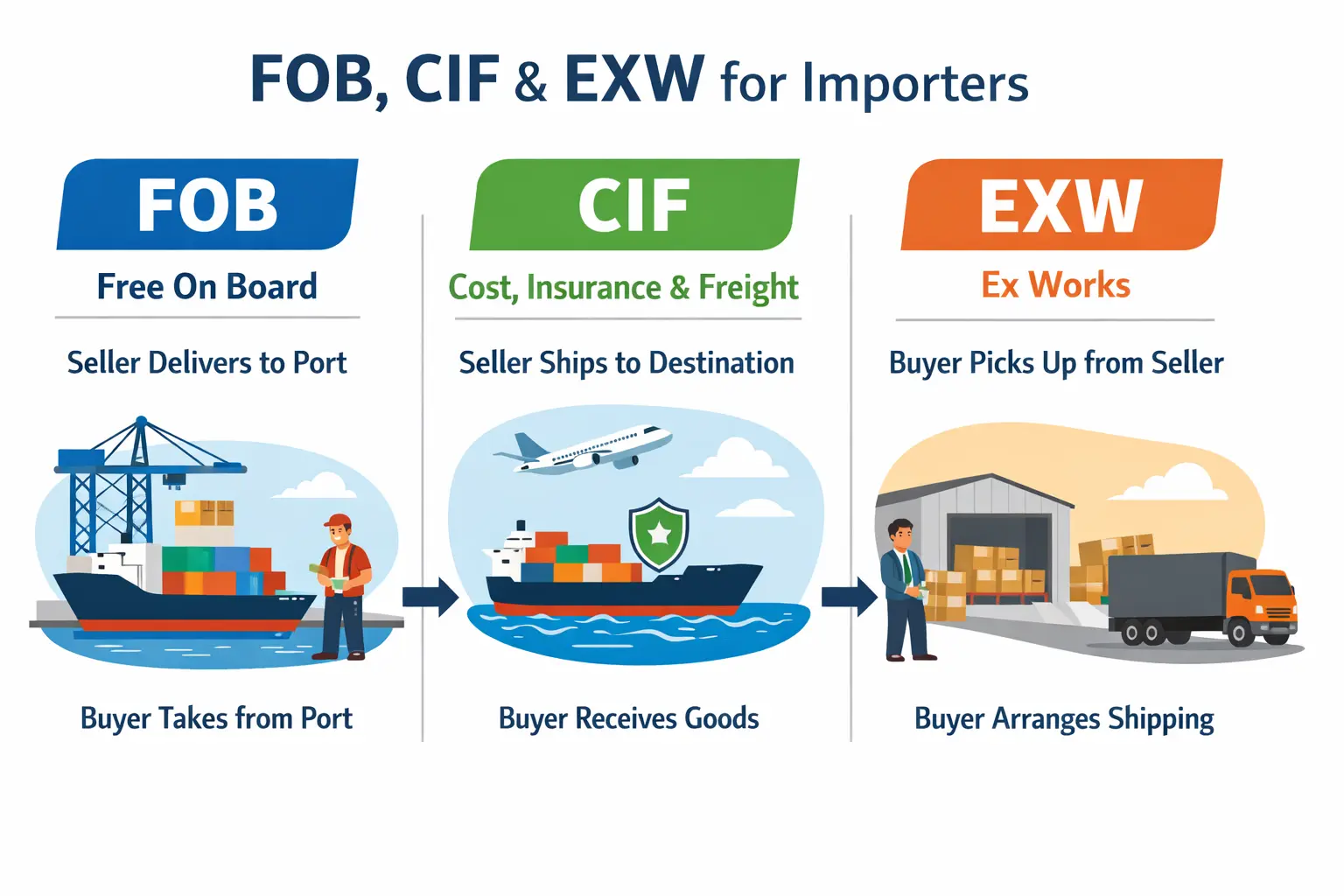
FOB, CIF & EXW for Importers are distinct terms and have different roles to play when it comes to shipping and cargo terminology. When we talk about FOB,  it  means the seller covers costs and risks until goods are loaded onto the ship at the port of origin. After this the buyer takes responsibility for transport, insurance, and import costs to the final destination. This defines a clear transfer point for ownership and expenses in international trade, especially for sea/waterway shipping.
 
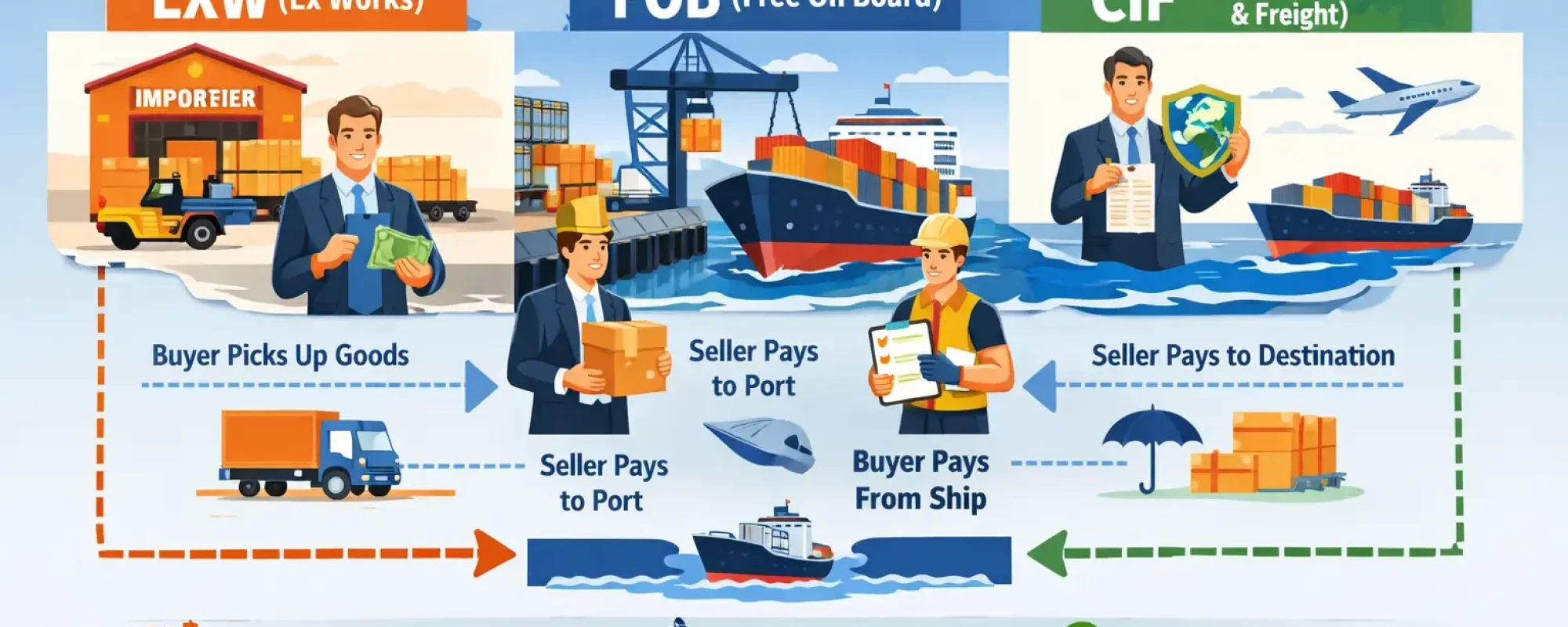
Under Ex Works (EXW), the buyer assumes maximum responsibility by collecting the goods directly from the seller’s location. In contrast, under FOB (Free On Board), the seller covers costs and assumes risks until they load the goods onto the vessel at the port of shipment. From that point onward, the buyer assumes control, thereby clearly defining the transfer of cost and risk between both parties.The key difference is the transfer point: EXW transfers risk at the seller’s facility, whereas FOB transfers it when goods are on the ship.

Key Aspects of FOB Shipping Terms

  • Transfer Point:
    • The critical moment occurs when the seller loads the cargo onto the vessel at the agreed port of shipment.
      Seller’s
  • Responsibilities:
    • Deliver the goods onto a vessel.
      Clear the goods for export.
    • Provide mandatory documents for import.
  • Buyer’s Responsibilities (from the transfer point):
    • Arrange and pay for the main ocean freight.
    • Bear all costs and risks for loss or damage.
    • Arrange insurance for the main voyage.
    • Handle import customs clearance along with duties.

Crucial Aspects of EXW (Ex Works)

  • Transfer Point:
    • The seller loads the cargo onto the vessel at the agreed port of shipment, marking the critical moment.
  • Seller’s Responsibilities:
    Deliver the goods onto a vessel.
    • Clear the goods for export.
    • Provide mandatory documents for import.
  • Buyer’s Responsibilities (from the transfer point):
    • Arrange and pay for the main ocean freight.
    • Bear all costs and risks for loss or damage.
    • Arrange insurance for the main voyage.
    • Handle import customs clearance along with duties.

Falcon is a specialised logistics provider offering end-to-end import-export services, including customs clearance from China and the UAE. We also cater to various industries, handling items like building materials, machinery, and consumer goods. For more information, call. :- +91 9311595648
Email:-  [email protected]

Cost Calculation (EXW Price)

It primarily includes production, packaging, and profit; however, it clearly excludes shipment taxes, which, in turn, are entirely the buyer’s responsibility. Therefore, the buyer must carefully account for these additional costs early on when planning the purchase. Furthermore, understanding these responsibilities helps avoid unexpected expenses and ensures a smoother transaction.
 
Imagine buying product from a factory. First, the seller hands you the box at their door. From there, you must first figure out how to get it out of the country; next, carefully navigate customs procedures. Subsequently, once this stage is completed, you need to arrange transport onto a ship or plane, and ultimately, in the final phase, ensure delivery to your final destination. Throughout this entire process, at every stage, you are responsible for paying for each step along the way; at the same time, you remain responsible for coordinating and managing every detail.

Cost, Risk, and Responsibility Comparison

CIF (Cost, Insurance, and Freight) is a commonly used Incoterm in imports where the seller covers the cost of goods, marine insurance, and freight up to the destination port, making it convenient for importers. However, risk transfers to the buyer once the goods are loaded onto the vessel at the port of origin, even though the seller pays shipping costs until arrival. The buyer handles import clearance, duties, unloading, and final delivery. CIF is used only for sea and inland waterway transport.
 
  • Sellers Responsibilities:
  • Packaging: Ensuring the cargo is properly packaged.
  • Loading Charges:  Costs associated with loading the shipment onto the first carrier from the sellers’ warehouse.
  • Delivery to Port/Place: Transportation costs associated with delivering the cargo from the seller’s warehouse to the port.
  • Export Duty, Taxes & Customs Clearance: Customs costs associated with sending the cargo.
  • Origin Terminal Charges: These are the handing charges at the loading port.
  • Loading on Carriage: The charges associated with loading the cargo onto the vessel.
  • Carriage Charges:  Cost of freight to move the shipment from loading port to the port of destination.
  • Insurance: Under CIF Incoterms, the seller is responsible for obtaining insurance policy on the shipment, until the port of destination.
Falcon Imports is a master in procurement.  The Falcon is engaged in a continuous endeavour to maximise potentialities. Exploring the multiple options of sourcing and procurement & thus creating excellent business opportunities. We believe in delivering a product that exceeds the expectations of our clientele by providing a combination of performance and value while establishing successful business relationships and alliances through active interactive communication. Gradually Falcon has successfully grown in the field of Freight Forwarding, Customs Clearing & Indenting with entirely operated offices in India and aboard. We offer door-to-door delivery services too. For more information: Phone No. :- +91 9311595648
Email:-  [email protected]

What Is the Most Preferred Incoterm for Importers Worldwide?

FOB (Free On Board) remains one of the most preferred Incoterms among importers worldwide, especially for sea shipments. Specifically, under FOB, the seller first delivers and then loads the goods onto the vessel at the port of origin, at which point cost and risk immediately transfer to the buyer. As a result, this arrangement clearly defines responsibilities and reduces potential disputes. Consequently, importers favor FOB not only because it clearly establishes responsibility, but also because it thereby enhances cost control. Moreover, this clarity further significantly reduces ambiguity in international trade transactions, and as a result, it ultimately makes FOB a more reliable, efficient, and transparent choice for global importers. As a result, this Incoterm allows importers to control freight arrangements, while also choosing their own insurance and additionally working with preferred logistics partners, thereby making it a cost-effective and transparent option within international trade.
Conclusion
Falcon Freight provides extensive import assistance in India, ensuring end-to-end logistics solutions. From air and sea freight forwarding through customs brokerage and documentation, the company seamlessly and efficiently manages every stage of the import process. Moreover, by maintaining a strong focus on compliance and operational efficiency, Falcon Freight consistently helps importers reduce delays, while simultaneously optimizing costs and ensuring smooth cargo clearance. In addition, backed by over 25 years of industry experience, we further bring deep expertise in managing regulatory compliance, along with handling specialized cargo and delivering fully integrated, end-to-end door-to-door logistics solutions.
 
Additionally, we also assist you by providing expert handling of customs clearance for both air and sea cargo, including document preparation as well as full regulatory compliance support. For more information: Phone No. :- +91 9311595648
Email:-  [email protected]