
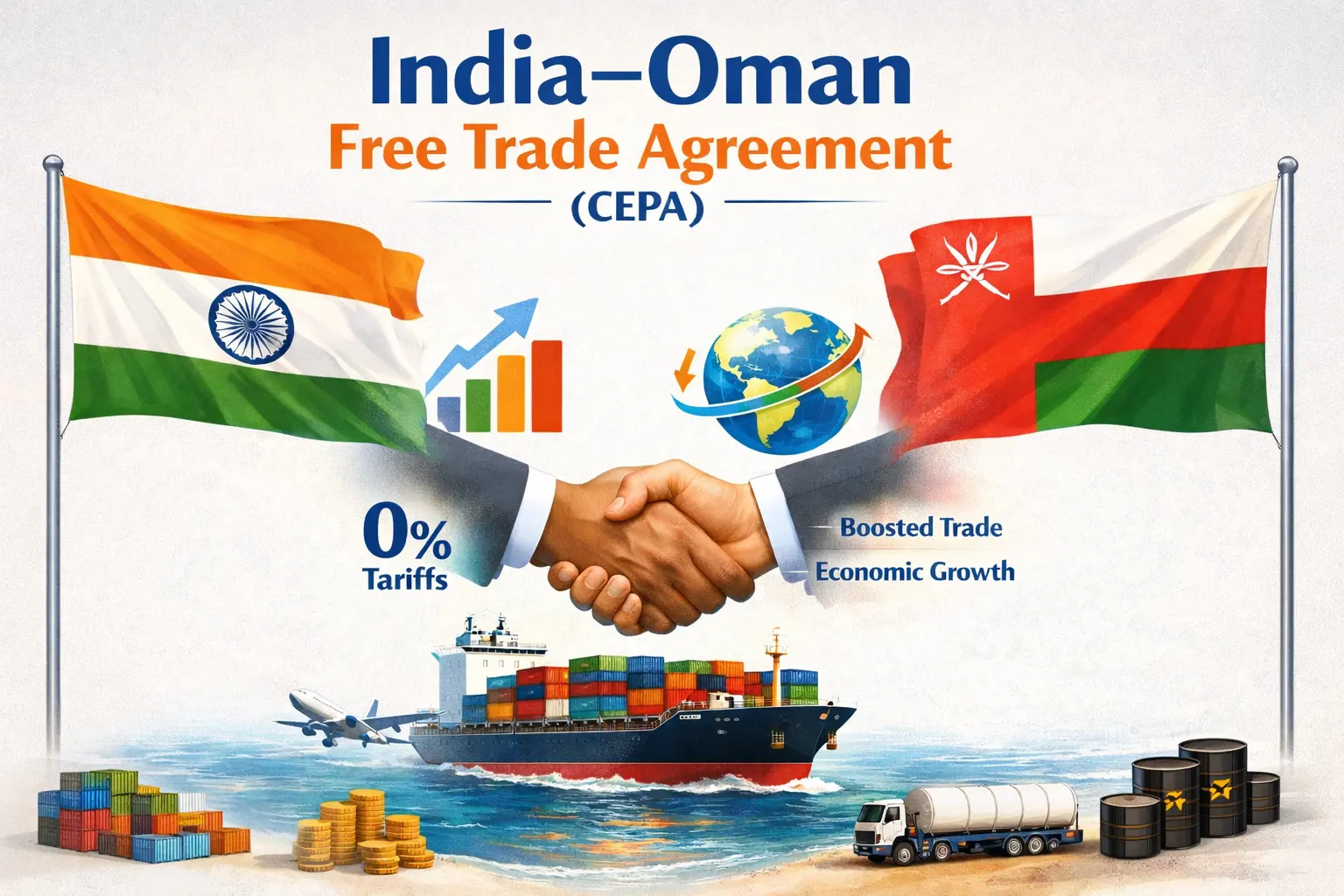
The India- Oman Free Trade Agreement, signed on December 18, 2025, marked a strategic milestone, providing India with 100% duty-free access for 98.08% of tariff lines. This landmark deal aimed to significantly boost bilateral trade beyond USD 10.61 billion (FY25) by cutting duties on crucial goods and improving services, investment, and professional mobility.
Introduction: The Comprehensive Economic Partnership Agreement (CEPA) between India and Oman marked a meaningful step forward in the economic relationship between the two nations. The agreement brought together trade in goods and services, investment, professional mobility, and regulatory cooperation under a single, coherent framework aiming at deepening bilateral economic integration.
Key Takeaways
- The India–Oman CEPA provides comprehensive framework covering goods and services trade, investment, professional mobility, and regulatory cooperation.
- Bilateral trade reached USD 10.61 billion in FY 2024–25, highlighting growing India–Oman economic ties.
- India gains 100% duty-free access in Oman across 98.08% of tariff lines, covering 99.38% of export value, effective from Day One.
- The agreement opens export opportunities in engineering goods, pharmaceuticals, agriculture and processed foods, marine products, textiles, chemicals, electronics, plastics, and gems & jewellery.
- A calibrated liberalisation approach, including an exclusion list, safeguards sensitive sectors while supporting MSMEs and labour-intensive industries.
The benefits & key highlights are immense. During FY 2024–25, bilateral trade between the two countries stood at USD 10.61 billion, compared to USD 8.94 billion in FY 2023–24. Trade from April to October 2025 stood at USD 6.48.
Merchandise Trade
- India’s exports to Oman were valued at USD 4.06 billion in FY 2024–25. During April– October 2025, exports stood at USD 2.57 billion, registering growth of about 5 percent.
- Imports from Oman amounted to USD 6.55 billion in FY 2024–25, whereas imports during April–October 2025 stood at USD 3.91 billion.
Services trade
- India’s exports to Oman rose from USD 397 million in 2020 to USD 617 million in 2023. It is led by telecommunications, computer and information services, other business services, transport, and travel services.
- Imports from Oman rose from USD 101 million to USD 159 million, along with key sectors including transport, travel, telecom services, and other business services.
Under CEPA, India secures 100 per cent duty-free market access for its exports to Oman, covering 98.08 per cent of Oman’s tariff lines. It accounts for 99.38 per cent of India’s trade value, based on an average for 2022–23. All zero-duty concessions apply from the first day of the agreement’s entry into force. It also provides immediate certainty to exporters. Currently, 15.33% of India’s export value and 11.34% of tariff lines enter Oman at zero duty under the MFN regime. Exports earlier facing duties up to 5%, worth USD 3.64 billion, are expected to gain from improved price competitiveness.

India’s Logistics & Air Cargo Event in Mumbai 2026
February 21, 2026

Liverpool Port, UK to India shipping services:
February 20, 2026
India-Oman Free Trade Agreement
February 10, 2026

US Agreement Impact on Russian Crude
February 6, 2026
The agreement opens export opportunities across an exclusive range of sectors, including minerals, chemicals, base metals, machinery, plastics and rubber. It is covering 94.81 per cent of India’s imports from Oman by value. Moreover it also safeguards manufacturing competitiveness and farmer interests.
Key Domestic Sectors are transport equipment, major chemicals. It also includes cereals, spices, coffee and tea, and animal-origin products. Sensitive value-chain industries include rubber, leather, textiles, footwear, petroleum oils, and mineral-based products.
Key Agricultural products such as dairy, oilseeds, edible oils, honey, , fruits and vegetables.
Sectoral Impact of the CEPA Engineering Goods: Oman is a key destination for India’s engineering exports. It reached USD 875.83 million in FY 2024–25, covering machinery, electrical equipment, automobiles, iron and steel, and non-ferrous metals.
- Under CEPA, all engineering products receive zero-duty market access.
- The agreement is set to benefit MSMEs—especially in iron, steel, and machinery—by enabling scale-up and deeper integration into Oman’s industrial supply chains.
- Tariff elimination on vehicles, auto components, and industrial equipment will also boost demand across construction, logistics, food processing, textiles, and chemicals.
Oman’s pharmaceutical market was valuing at USD 302.84 million in 2024 and will project to reach USD 473.71 million by 2031. It is growing at a 6.6 per cent. The market remains heavily import-reliant, creating sustained demand for external suppliers.
- Under CEPA, binding zero-duty access is available for key finished medicines, vaccines boosting competitiveness in public private procurement, and core active pharmaceutical ingredients. They include penicillins, streptomycins, tetracyclines, and erythromycins, supporting stable pricing and long-term supply arrangements.
- The agreement introduces regulatory fast-tracking for pharmaceutical products. They get approved by recognized stringent authorities.
- Good manufacturing practices maintain quality standards and reduce compliance costs along with approval timelines.
Marine products: Oman’s imports of marine products stood at USD 118.91 million during 2022–24, whereas imports from India were USD 7.75 million. This indicates considerable scope for export expansion. The CEPA expects supporting higher exports of Indian seafood products such as shrimp and fish to Oman.
- Under CEPA, marine products receive immediate duty-free access, replacing earlier import duties of 0 to 5 per cent and delivering immediate price competitiveness for Indian exporters.
- Given the labour-intensive nature of the marine sector, expanded market access holds potential for employment generation. Product-level data highlighted untapped potential in key categories. India’s exports of Vannamei shrimp to Oman were USD 0.68 million in 2024, compared to India’s global exports of USD 3.63.
Oman’s agricultural imports increased from USD 4.51 billion in 2020 to USD 5.97 billion in 2024. It recorded a CAGR of 7.29 per cent. In 2024, India held a 10.24 percent share of Oman’s agricultural imports, ranking as the second-largest supplier. At that time, India’s agricultural exports to Oman rose from USD 364.67 million to USD 556.34 million, registering a strong CAGR of 11.14 per cent. Exports of APEDA-scheduled products grew from USD 299.49 million to USD 477.33 million. Major export items included basmati, bananas, potatoes, onions, butter, fish body oil, prawn and shrimp feed, and frozen boneless bovine meat.
Key Gains in Agricultural Products:
- Boneless meat of bovine animals – Duty-free access reinforces India’s dominant supplier position, with a 94.3% share in Oman’s USD 68.27 million import market.
- Fresh eggs – Zero-duty access consolidates India’s 98.3% share, making Oman India’s largest export destination for eggs.
- Sweet biscuits – Duty-free entry strengthens India’s position in Oman’s USD 8.05 million biscuits market, improving competitiveness against Turkey, UAE and Saudi Arabia.
- Butter – Elimination of 5% tariff improves India’s price competitiveness in Oman for exports valued at USD 5.75 million, giving India an edge over Denmark, Saudi Arabia and New Zealand.
- Natural honey – Tariff elimination improves India’s price competitiveness in Oman’s USD 6.61 million honey market. Here India holds 19.2% share, giving India an edge over Australia, China and Saudi Arabia.
Plastics, Gems, Jewellery & Investment Services
- India’s global plastics exports reached USD 8.11 billion in 2024. It reflected strong production capacity and export- readiness.
- Under CEPA, plastics and plastic articles receive immediate duty-free access. It has replaced the earlier 5 per cent import duty and is improving price competitiveness for Indian exporters.
- India’s plastics sector is largely MSME-driven, improved access to the Omani market is expected to support inclusive export growth and strengthen employment-intensive manufacturing sector.
Gems & Jewellery: India is a major global player in this sector, with annual exports exceeding USD 29 billion. Whereas Oman imports around USD 1.07 billion worth of gems and jewellery annually. It indicates substantial untapped potential.
- With duty-free access, the agreement is expecting to open further opportunities in the Omani market. It is particularly meant for cut and polished diamonds, gold and silver jewellery, and emerging segments such as platinum and imitation jewellery.
- Import duties of up to 5% on Indian gems and jewellery have been eliminated, boosting market access and price competitiveness for exporters.
Services, Investment and Professional Mobility Services: They are a key pillar of the India–Oman CEPA. In 2024, bilateral services trade stood at USD 863 million, with exports of USD 665 million and imports of USD 198 million. This resulted in a surplus of USD 447 million for India. Oman’s services imports total USD 12.52 billion, with India holding a 5.31% share—highlighting significant untapped potential for Indian providers.
Conclusion
The India–Oman CEPA establishes a comprehensive framework for trade, investment, services, professional mobility, and regulatory cooperation, while maintaining balanced market access and safeguards. The agreement expects to boost bilateral trade. TBT Agreement aims to ensure that technical regulations, standards, and conformity assessment procedures are non-discriminatory. This does not create unnecessary obstacles to the trade. SPS Agreement concerns the application of food safety and animal and plant health regulations. This would lead to generating employment, strengthen supply chains, and support deeper and more sustained economic engagement between India and Oman. Falcon is a specialist in Import-export consultancy providing customs clearance, freight forwarding and regulatory support services.