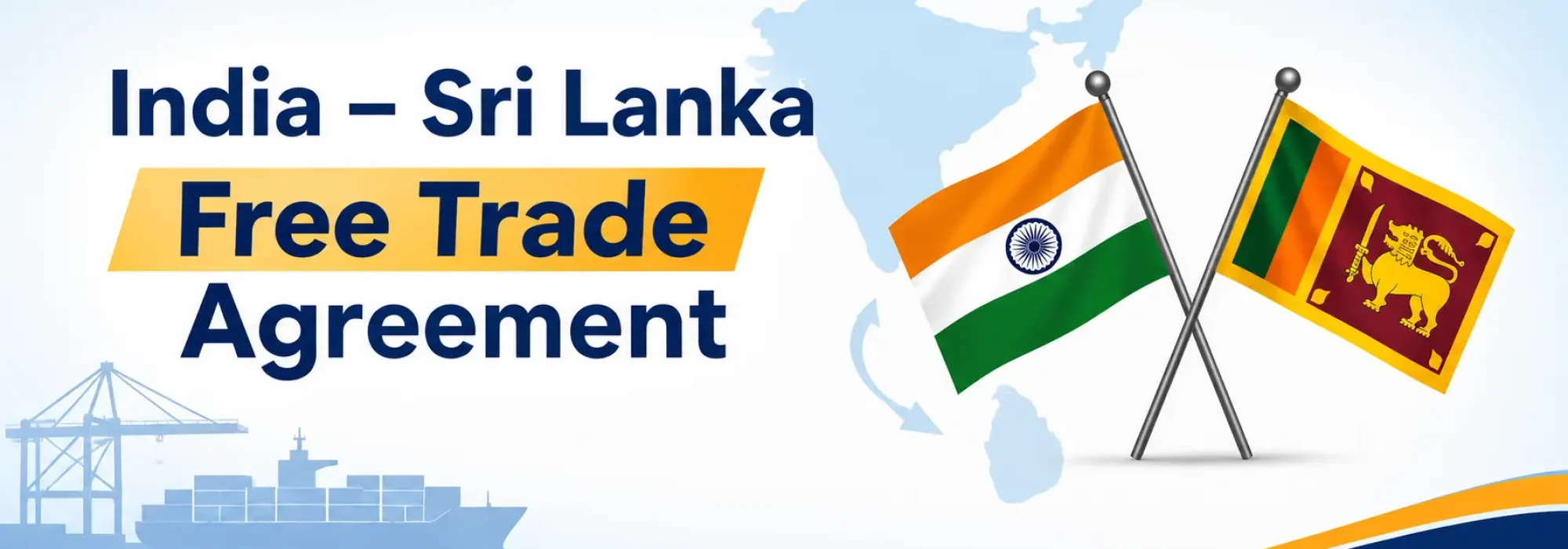
India – Sri Lanka Free Trade Agreement
India and Sri Lanka are working to strengthen their economic ties by updating the India–Sri Lanka Free Trade Agreement (FTA), which has been in place since 2000. The latest talks focus on modernising the agreement and expanding bilateral trade and investment. The ISFTA, signed on 28 December, 1998, focused on eliminating tariffs and promoting free trade in goods between the two countries. Moreover, this pact covered physical merchandise rather than services or investments. As part of the Negative List, both countries maintained lists of sensitive products exempt from duty-free treatment.
In the latest framework (ETCA), there is expansion into the services sector (such as IT, maritime logistics, and financial services), economic technology partnerships, and investment protection rules. Additionally, the emphasis is on product-specific standards that fit modern global supply chains.
Evidently, there are investment protections and reduced trade costs for small and medium businesses through digital customs processes. Both nations are focusing on deep regulatory harmonisation, mutual recognition of professional qualifications, and a more integrated economic space, akin to a single-market framework.
However, the key outcomes of the Visit are:
- Free Trade Agreement: Both sides will accelerate negotiations to modernise the ISFTA 2000.
- Social Security Pact: Furthermore, the two sides concluded discussions on a bilateral social security framework.
- Financial Assistance: Additionally, both countries exchanged agreements on INR-denominated Lines of Credit worth USD 350 million.
- Strategic Projects: Along the same lines, both nations addressed the status of key energy and connectivity initiatives. The Sampur solar power project and Trincomalee energy hub development are examples.
India–Sri Lanka FTA Agreement Updates - 2026
India and Sri Lanka are working to strengthen their trade and economic relationship by updating the existing Free Trade Agreement and expanding cooperation into new areas. Here are the key latest developments:
- Updating the 2000 FTA: India and Sri Lanka have agreed to work on updating the existing India–Sri Lanka Free Trade Agreement (ISFTA), which has been in place since 2000. Both sides are looking to speed up the revision of the agreement’s formal text.
- Social Security for Workers: The two countries are also making progress on a proposed Social Security Agreement. This could make it easier for professionals and workers who move between India and Sri Lanka to access social security benefits.
- Improved Power Connectivity: India and Sri Lanka are discussing a proposed High Voltage Direct Current (HVDC) power link between the two countries. The project could improve electricity connectivity and support long-term energy cooperation.
- Infrastructure Financing: Both countries are also discussing INR-denominated credit lines that could be used to support infrastructure and development projects in Sri Lanka.
- ETCA Discussions Continue: Discussions on the proposed Economic and Technology Cooperation Agreement (ETCA) are also continuing. While the current ISFTA mainly covers goods, ETCA could expand cooperation into services, technology, investment and trade facilitation.
- More Opportunities for Businesses: The planned changes could make trade between India and Sri Lanka easier and create new opportunities for businesses in areas such as goods, services, investment and technology.
1974 Indo-Sri Lanka Agreement- the Foundation
The origin of India-Srilanka Free Trade Agreement dates back to 1974 Indo-Sri Lanka Agreement. This treaty was an important benchmark in the bilateral relations between the two countries. Furthermore, The pact focussed mainly on mutual development, economic support, and cultural exchange, it was not a free trade agreement. The 1974 trade agreement paved the way for stronger economic relationship by signing of the ISFTA in 1998.
ISFTA: A Synopsis
India Sri Lanka Free Trade Agreement was entered by the two neighbouring South Asian nations to boost the trade between them. A mutual benefit of duty free access to the market is a key feature of the pact. Particularly, this agreement is a key for Sri Lanka to get wide access to the market of India, while India benefits from strategic location and fostering economy of Sri Lanka.
In order to get the best information when it comes to Free Trade Agreement between India and Sri Lanka, contact Falcon India at +91-9311595648 or reach us by email at cargodeal@falconfreight.com
Why Is the India–Sri Lanka FTA Important for Businesses?
The FTA can provide significant advantages for eligible exporters and importers.
- First, preferential tariff treatment can make qualifying products more competitive in the destination market. Lower customs duties can reduce the landed cost of goods and potentially improve customer pricing.
- Second, the agreement provides a structured framework for bilateral goods trade. This helps businesses understand the conditions they need to meet when seeking preferential treatment.
- Third, the growing economic relationship between India and Sri Lanka is creating opportunities across manufacturing, agriculture, food products, petroleum products, industrial inputs and other commercial sectors.
However, businesses should not assume that every product automatically receives zero duty. Product-specific tariff treatment, exclusions, quotas and rules of origin must be checked before claiming an FTA benefit.
What Products Can Benefit From ISFTA?
ISFTA provides preferential treatment for eligible products, but the exact benefit depends on the product and its applicable tariff conditions.
Businesses commonly involved in India–Sri Lanka trade include sectors such as:
- Petroleum and petroleum-related products
- Food and agricultural products
- Machinery and industrial equipment
- Manufacturing inputs
- Pharmaceutical products
- Textiles and apparel
- Chemicals
- Automotive and engineering products
Before exporting, businesses should verify the HS code, applicable tariff concession, negative-list restrictions and rules of origin for the specific product.
This step is important because the same general product category can have different tariff treatment depending on its exact HS classification.
For more export services from Sri Lanka, please click here↗️
ISFTA and ETCA: What Is the Difference?
The distinction between ISFTA and ETCA is important.
- ISFTA is the existing India–Sri Lanka trade agreement that focuses on goods and tariff concessions. It entered into force in March 2000.
- ETCA, on the other hand, has been proposed as a broader framework to deepen economic and technological cooperation between the two countries. Discussions have included areas such as trade facilitation, services, investment and technology cooperation.
As of 2026, the Government of India continues to list the India–Sri Lanka ETCA upgrade as under negotiation. Therefore, businesses should not treat ETCA as an agreement that has already replaced ISFTA.
Conclusion
India and Sri Lanka agreed to set up a joint working group to modernise their existing India-Sri Lanka Free Trade Agreement (ISFTA) into an updated economic partnership. Thereby, the nations are shifting from basic value-addition thresholds to product-specific standards that fit modern global supply chains. In addition, both sides are expanding trade to cover high-value fields like IT, finance, and maritime logistics.
Falcon helps businesses navigate the India–Sri Lanka Free Trade Agreement (ISFTA) by helping manage specific Domestic Value Addition (DVA) thresholds (minimum 35%) and tariff head changes required under the ISFTA.
For more information:
Phone No. :- +91 9311595648.
Email :- cargodeal@falconfreight.com