
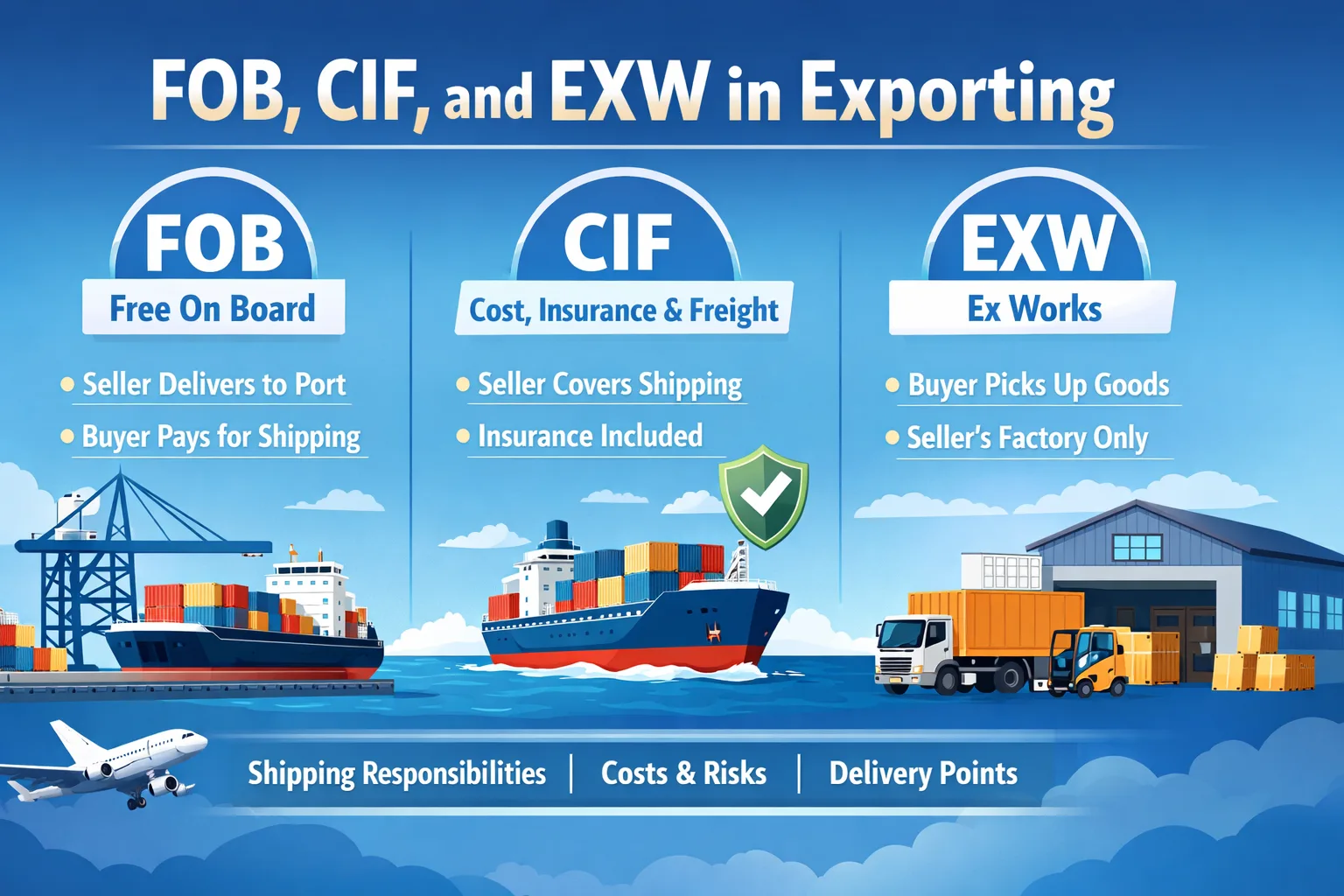

When this question is raised” What is FOB, CIF, and EXW in Exporting?” the answer is plainly simple and it lies in understanding the role and responsibilities undertakenby the seller or buyer. Free on Board (FOB) in export signifies that the seller delivers goods on board the vessel for shipment. The seller covers export clearance and costs, while the buyer assumes all risks and costs for freight, and insurance.
The seller assumes the following responsibilities:
- Export Packaging: Arranging export packaging so the cargo can be shipped safely.
- Loading Charges: Expenses incurred during the loading process at the seller’s warehouse.
- Delivery to Port: Trucking fees incurred while moving cargo from the warehouse to the port of loading.
- Export Duty, Taxes & Customs Clearance: Ensuring the cargo is exported correctly.
- Loading on Carriage: The seller is responsible for the costs incurred to load cargo onto the carriage.
When a buyer agrees to purchase goods under the Incoterms of FOB, they consent to the following responsibilities and risks:
- Freight Charges: Carriage charges to ship the cargo from the loading port.
- Insurance: It is the buyer’s decision if they prefer to purchase an insurance policy for shipment.
- Destination Terminal Handling Charges: The buyer is responsible for DTHC.
- Delivery to Destination: Once the cargo unloads, the buyer is responsible for final carrier fee to deliver the goods.
- Unloading at Destination: During unloading at the buyer’s warehouse, the buyer is responsible.
Responsible for taxes and fees associated with customs clearance.
Falcon offers end-to-end -export services, including customs clearance from China and the UAE. We also cater to various industries, handling items like building materials, machinery, and consumer goods. For more information,
📩Email: cargodeal@falconfreight.com.
Cost, Risk, and Responsibilities for export:
The cost, insurance and freight differ with the type of shipping agreement one prefers. Cost, Insurance, and Freight (CIF) is an Incoterm requiring seller to cover costs, insurance, and freight to deliver goods at a designated destination port, primarily for sea/waterway transport. It’s an international shipping agreement, which represents the charges paid by a seller to cover costs, insurance, and freight of a buyer’s order while the cargo is in transit.
Seller’s responsibilities include:
- Purchasing export product licenses.
- Providing inspections of products.
- Any charges or fees for shipping and loading the goods to the seller’s port.
- Packaging costs for exporting cargo
- Fees for customs clearance, duty, and taxes (for exporting)
- Cost of shipping the freight from the seller’s port to the buyer’s port of destination
- Cost of insuring shipment until the buyer’s port of destination
Buyer’s Responsibilities
Once the goods have arrived at the buyer’s destination port, the buyer assumes responsibility for the costs associated with importing and delivering. Unloading the product at the port terminal
- Transferring the product to the delivery site
- Custom duty charges and associated with importing goods
- Charges for transporting, unloading, and delivering the goods.
How & Why to Choose the right term for Exporting:
Sometimes you do not know how and why to choose the right term for exporting your goods. You should prefer the shipping terms suiting to your needs and convenience. Otherwise you may regret for your ignorance. Going ahead, EXW (Ex Works) is an Incoterm where the seller makes goods available at their premises (factory, warehouse, etc.), imposing maximum responsibility on the buyer. The buyer covers all costs, risks, transportation, and export customs clearance. In this way a seller fulfills his obligation by making goods available at their premises (factory, warehouse). The buyer bears all risks, costs, and responsibilities for loading.
Sellers Responsibilities:
Under the EXW Incoterms, the seller’s responsibilities are incredibly low. Essentially, their only requirement is to ensure that the cargo is packaged so that it is ready for export, and the goods can be collected from their location. Once the cargo is ready, it must be in an area where the buyer can collect it from the seller.
Buyers Responsibilities:
- Loading Charges: Loading cargo at the location of the pickup so that the goods can move to the port for export.
- Delivery to Port/Place: Transporting goods to the port of origin, to begin export process.
- Export Duty, Taxies & Customs Clearance: Export documentation, and paying any duty to export the cargo. The buyer must rely on their own methods of export.
- Loading on Carriage: The responsibility associated with loading the cargo onto the carriage.
- Carriage Charges: All freight costs associated with moving the cargo from port to port.
- Import Duty, Taxes & Customs Clearance: All duty and taxes associated with importing the cargo into the destination country.
Conclusion
With our experienced and well-trained staff, Falcon Freight Group offers efficient and trouble free customs clearing services for all types of products. Falcon specialises in clearing, documentation, and forwarding for both sea and air freight. It also helps in Assistance with shipping bills, packing lists, and other necessary export documents. For more information:
📞Phone: +91 9311595648.
📩Email: cargodeal@falconfreight.com.