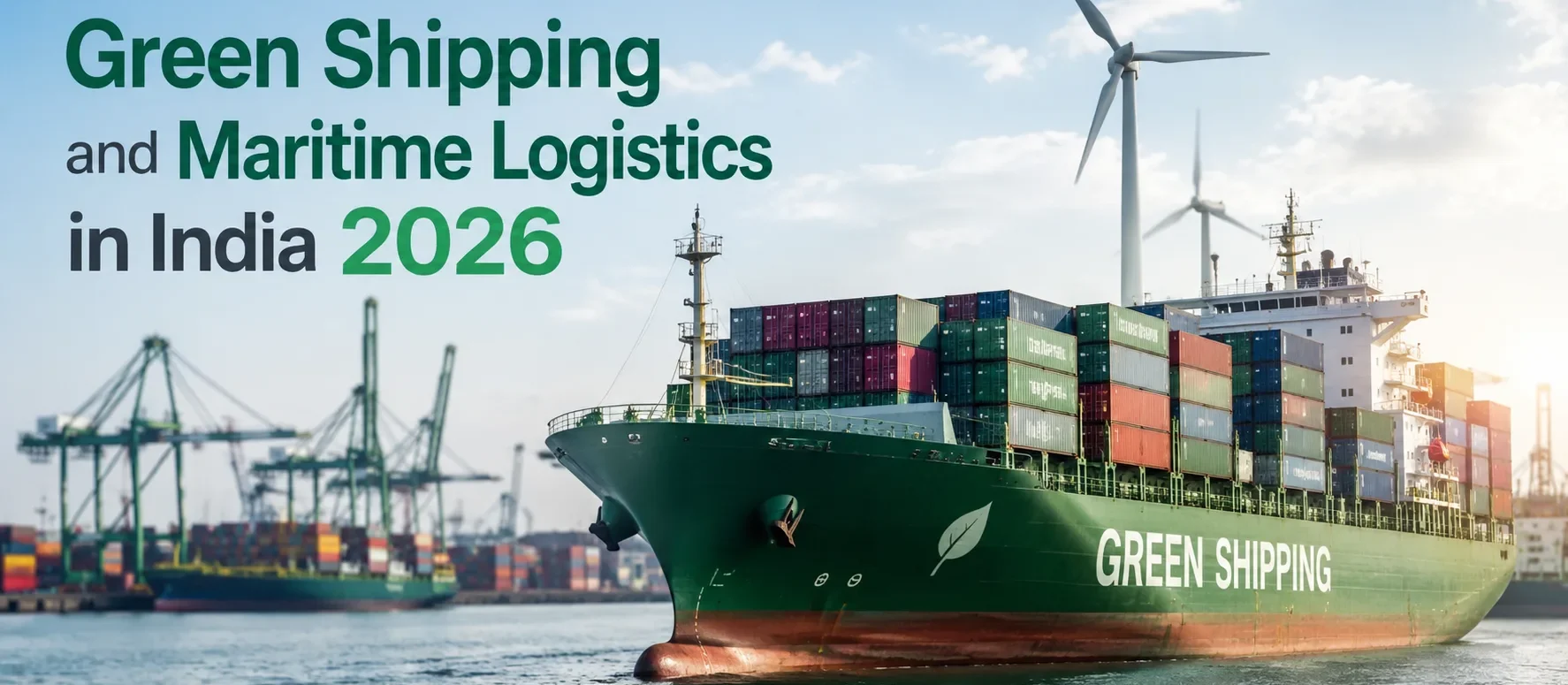
Green Shipping and Maritime Logistics in India 2026: The Green Shipping and Maritime Logistics in India 2026 has focus emphasising on achieving net-zero emissions by 2050. Furthermore, the crucial drivers are the National Green Shipping Policy. This policy enhanced subsidies up to 30% for constructing green vessels. In addition, they have a strategy to conduct operations on 20 new national waterways. In this way, they will be able to decarbonize freight.
The Crucial pillars of the Green Agenda in 2026 are:
National Green Shipping Policy (NGSP): This policy emphasises on seven pillars: These are the green ships, alternative fuels (such as green hydrogen), sustainable ship recycling, green ports, eco-technologies, green financing, and workforce capacity building. In fact, green ships are ocean vessels which help to minimize their environmental impact. It means that they are working to make sure that they cut down on greenhouse gases emissions. They make use of energy-saving designs. Along with that, alternative marine fuels like hydrogen, ammonia, biofuels, and wind assistance will be used as fuels.
Shipbuilding Financial Assistance: The government provides 25%–30% financial assistance for the construction of green, hybrid, or specialized vessels. However, they must meet the domestic value addition requirements. “Green vessels” basically refer to commercial ships and boats meant to minimize carbon emissions. Additionally, they help conserve energy in the long run. They also use eco-friendly technologies like zero-emission green hydrogen, ammonia, or hybrid solar-wind power.
In case of Hybrid vessels, they combine conventional combustion engines (typically diesel) with rechargeable battery systems. This type of a setup optimizes power delivery, reduces fuel consumption by up to 45%. Moreover, they dynamically balance power requirements between the main engine and the battery.
Green ports initiative: Eco-friendly shipping
Green Ports & Eco- friendly Shipping Infrastructure are adopting renewable energy (solar/wind) as fuels. Furthermore, they are implementing shore-to-ship power for idle vessels, and electrifying cargo-handling equipment. These are done through the Sagarmala Programme. Likewise, shore power is used for supplying a vessel in port with electricity from the shore instead of generating power onboard.
In other words, they plug in to an onshore electricity grid when in port. With shore power, the vessel does not have to use its auxiliary engines to generate power. Overall, this reduces emissions and noise. Shore power can charge the energy storage system on board the ship. With the passage of time, shore power is becoming a standard feature in new vessels. Slowly and gradually, it is becoming a popular retrofit for existing fleets.Above all, the Green Shipping and Maritime Logistics in India 2026 has focus emphasising on achieving net-zero emissions by 2050. Mundra port, Nhava Sheva port, Kandla port, Chennai Port, Vishakhapatnam Port and Cochin port are some of India ‘s major export ports.Additionally, shore power solutions are essential for helping maritime operations more sustainable. Green ports initiatives designs reduce the environmental footprint of maritime hubs and shipping.Falcon Freight helps businesses achieve their sustainability goals in 2026 through AI-driven route optimization, supply chain digitization, and multimodal transport planning. Moreover, they assist in reducing carbon footprint. Moreover, they maintain cost-effectiveness across ocean, air, and land freight.
Furthermore, these programs focus on reducing carbon emissions, improving air and water quality. They promote renewable energy, eco-friendly fuels, and waste management.
Green hydrogen shipping
Green hydrogen shipping is a vital clean energy solution for decarbonizing the global maritime sector. In other words, it is basically used in fuel cells to generate propulsion. It makes use of water vapor as the only emission. Pure hydrogen is highly promising for short-sea shipping and inland barges. Above all, it has low energy density and demands storage requirements. So hydrogen-based derivatives like green ammonia and green methanol are often preferred for vast, long-haul ocean vessels.
Benefits of Using Hydrogen as Fuel: If it is processed using renewable energy, green hydrogen cuts greenhouse gas emissions by up to 100%. Thus, it is far better as compared to traditional heavy fuel oil (HFO). Hydrogen fuel cells run quietly, and have fewer moving parts than internal combustion engines. In addition, they eliminate particulate matter and sulphur oxides completely. Global ports are establishing infrastructure for localized and international green shipping routes.
Inland Waterways: To reduce highway congestion and emissions, 20 additional national waterways are under development across the country. Furthermore, these feature major terminals for greener, multimodal cargo transport. They comprise a key, fuel-efficient, and eco-friendly transportation network of navigable rivers, canals, backwaters, and creeks.
In a nutshell, they are used for moving both freight and passengers. This is often an alternative to road and rail. This mode of transport helps reduce traffic congestion and lower carbon emissions. Cargo transportation on these waterways has tremendous growth. They have achieved a record-high of 145.84 million metric tonnes recently.
The Inland Waterways Authority of India (IWAI) is the main agency for the development, maintenance, and regulation of national waterways for shipping and navigation.”The best logistics services”
Conclusion
India’s maritime sector in 2026 is rapidly growing from compliance-driven infrastructure into a hub of sustainable decarbonization. India is successfully balancing rapid trade expansion with assertive climate goals. There is a push for green shipping and maritime logistics. It marks a transformative leap ahead for the region’s economy and its environmental footprint. Now India has alternative fuel supply chains (like green hydrogen and ammonia), and is digital monitoring across a unified framework.
With the industry heavily focused on global decarbonization and transitioning to green corridors, Falcon Freight facilitates eco-friendly supply chains in several key ways:
For more information:
Phone No.:- +91 9311595648.
Email:- [email protected]