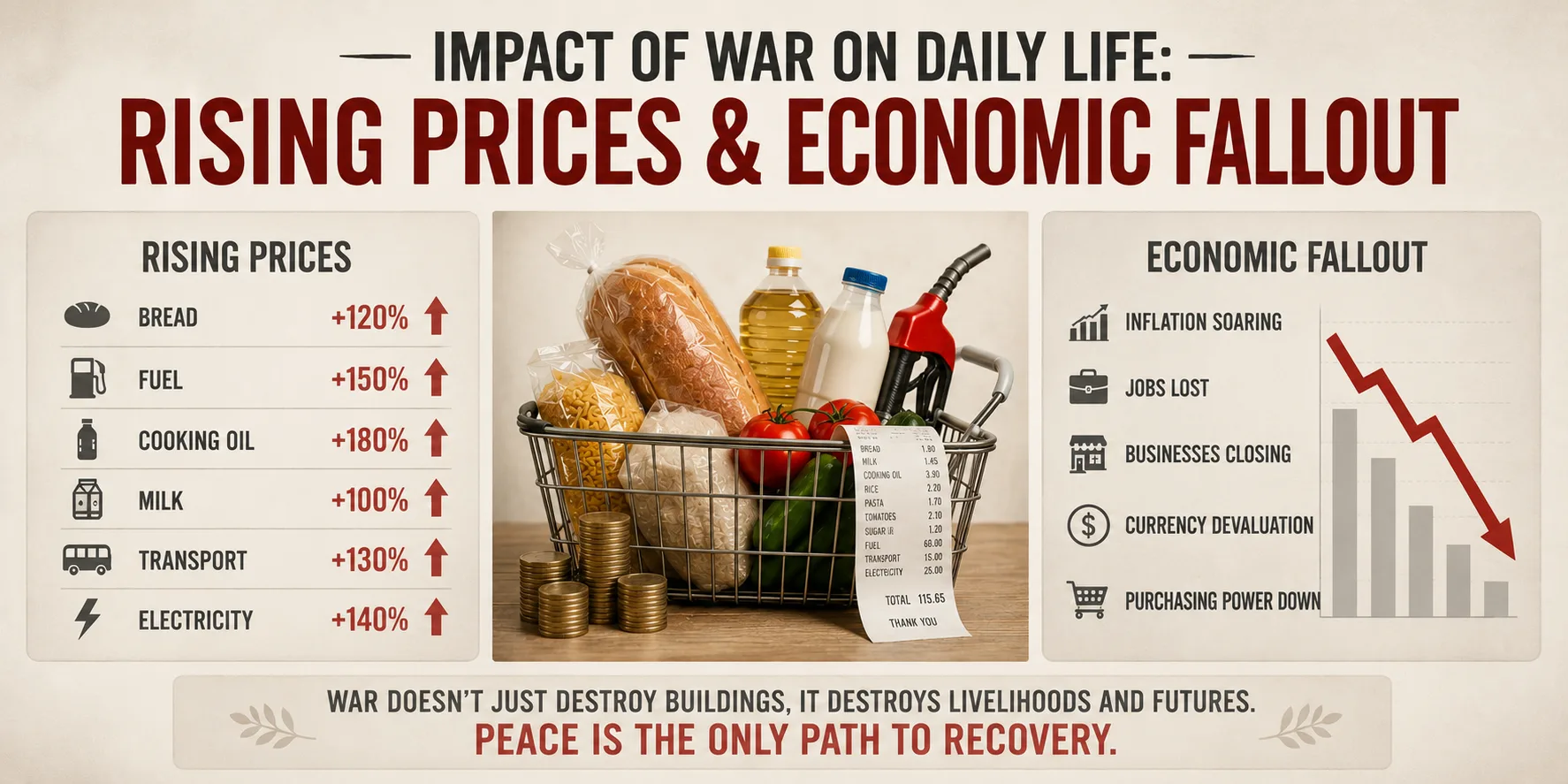
The Israel–Iran War Impact on Daily Life and Rising Prices is increasingly visible in everyday life. The cost of war is price rise, & darker days ahead. Actually, almost everyone gets a hit, particularly the low-income and the lower middle class. A packet of milk, a simple thali meal, or an air conditioner has become an almost non-negotiable purchase. Furthermore, everyone is getting a hit in such trying times, and add to that the sweltering heat; there is no respite whatsoever. So, the cost of the West Asia war is such that it is spreading like wildfire.
The fact is that it is just the initial stages of the war and it has caught everyone by its grip. It is making us pay more for a lot of things. Similarly, packaged consumer goods, gold jewellery, a box of paint, a restaurant feast or an air ticket; they all seem to be too tempting. However, we all are paying a price for a war we did not start. Funnily though, the ones that started the war do not just know how to end it. Such is the irony of a war. When supply falls however, demand is the same, prices usually rise.
Be it LPG costs which generally affect the eateries directly or hike in gold import duty, the war has touched no sector untouched. Moreover, Mundra port, Nhava Sheva port, Kandla port, Chennai Port, Vishakhapatnam Port and Cochin port are some of India ‘s major export ports. Most countries depend on others for resources like oil, grain, metals, and fertilizer. Today, wars fought thousands of kilometers away still influence the price of everyday things in our lives.
How war affects inflation
Oil prices rise whenever a war is fought and it takes the form of a global conflict. Overall, companies across many segments have already taken one round of price hikes. They have been contemplating for another round of price hike because of spike in input costs. Furthermore, this happened on the back of disruption of energy supplies. India’s economy is dependent on oil imports. This is why, India is finding it hard to access supplies it needs, even at higher prices.
At the same time, it is inflating household budgets too. For instance, Blue Star has taken a 5% price hike in Acs on an average linked to energy- change norms. Another 8% is going to increase to cope with high raw material costs and fluctuation in exchange rate. At present, AC makers are reeling under high commodity inflation. In large manufacturing economies, higher fuel and power bills raise production costs and limit people’s purchasing power. Most importantly, fertiliser and fuel are vital for farming. Since supplies from the Gulf region are constrained by conflict, their prices have climbed.
Now the demand impact is another challenge to tackle going ahead. For companies a controlled domestic inflation had long been a buffer amid global macro- volatility. However, the war has changed that equation and posing worries for consumption from here on. When energy is expensive, it affects almost everything since transportation, manufacturing, and heating all depend on it.
If wanted to know more about : war related crises ; click here ↖

Economic consequences of conflict
Food, manufactured goods and services all have become costlier in this war scenario. For instance, Amul recently raised the prices of fresh pouch milk by Rs. 2 per litre. They say that there has been a substantial increase in cost of cattle feed, milk packaging film and film during the year. Inflation from war doesn’t stay in one country. in additioin, the global economy is so connected, disruptions affect prices worldwide. In addition to higher commodity prices, countries, companies, and consumers already face the effects of these supply‑chain complications.
Moreover, Godrej Consumer Products Limited has hiked the prices in the range of 4-7 % across soaps, detergent, and household insecticide categories. Marico has taken about 6-7 % price increase already. Furthermore, the biggest player Hindustan Unilever Limited has effected a 5% increase and beckons that more could be in the offing. Conflicts lead to higher prices for groceries, airline tickets, and even clothing. Oil-price spikes have pushed inflation higher and growth lower. At this stage, elevated inflation across the globe is eroding households’ real income and living standards.
Conclusion
The recent hike in gold import duty will lead to dip in near-term sales volume. Moreover, policy shifts and higher prices that arrive unexpectedly mean consumers put off non- essential purchases for a while. War severely damages global supply chains and diverts huge sums of money from vital social priorities like healthcare and poverty alleviation. When a conflict breaks out, production slows down or stops completely. likewise, shipping routes also close, factories shut down, and exports too are restricted. A short conflict sends oil and gas prices soaring, while a long one keeps energy expensive. Similarly, this strains countries like India that rely on imports. In addition to higher commodity prices, countries, and consumers are facing the effects of these supply‑chain complications.
Falcon Freight can help you navigate supply chain volatility and escalating conflict-driven costs.
For more information:
Phone No. :- +91 9311595648.
Email :- cargodeal@falconfreight.com