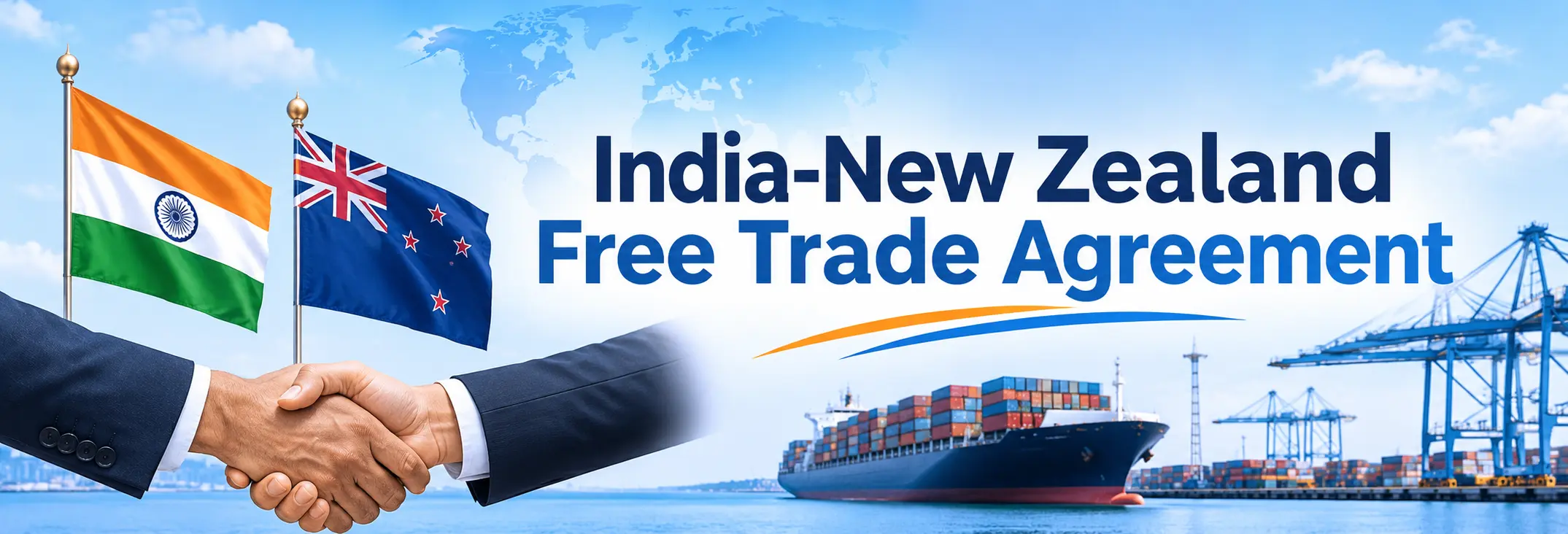
India-New Zealand Free Trade Agreement
A Customs House Agent(CHA) has responsibilities that include preparing and submitting all documents for shipment under the Harmonised System (HS) code; they calculate the duties and taxes and coordinate with customs officers when required. The Import Export Custom House Agent(CHA) in Delhi operates the important role for international trade by managing the complex process of customs clearance.
India-New Zealand Free Trade Agreement History
- The Early Phase (2010-2015): India and New Zealand began official trade talks in April 2010, and over the next 5 years both countries held 10 formal rounds of talks. However, negotiations stalled completely in 2015 over dairy and agricultural products.
- The Resumption (2025): On March 17, 2025, India and New Zealand came up with a new approach to resume negotiations. New Zealand decided to respect India’s confidential exceptions. On the other hand, India compromised on several items. After 9 months of negotiations, both countries concluded the discussions, and the India-NZ FTA became one of India’s fastest-concluded trade deals.
- The Deal Closing (2026): Both countries closed the trade deal in New Delhi on 27 April 2026. Later, the New Zealand Parliament passed the enabling ordinance in September 2026, and the Agreement thus came into force on 21 October 2026.
Benefits of The India-NZ FTA for India

- Market Access: With the India-NZ FTA, India will gain access to a premium market. This will increase India’s exports to New Zealand. Moreover, this trade deal will increase demand and competition for Indian products in the international market.
- Tariff Reduction: New Zealand has granted 100% duty-free market access to Indian products. This tariff reduction extends to all categories of Indian goods. Additionally, the tariff relaxation and duty-free export access take effect on the date the agreement is executed.
- Investment Commitment: New Zealand is committing to invest $20 billion over the next 15 years in India. This commitment will support collaborations in infrastructure, innovation, and agriculture.
- Boost to Indian MSMEs: Moreover, several Indian MSMEs and startups will receive a boost from the new India-New Zealand Free Trade Agreement. With the trade deal removing high tariffs, Indian MSMEs will gain access to a premium market to sell their products.
- Professional and Student Mobility: Indian professionals are gaining better work opportunities in New Zealand. This includes IT, engineering, healthcare, education, construction, as well as AYUSH practitioners, yoga instructors, Indian chefs, and music teachers. Additionally, the deal commits to better post-education work opportunities for Indian students studying in New Zealand.
New Zealand’s Benefits in The Trade Agreement
- Primary Industry and Resource Gains: Following the trade agreement, India has also reduced customs duty on products from New Zealand. This includes core Kiwi commodities like timber and forestry products, wool, coal, and leather hides. Additionally, India has reduced the 33% tariff on premium hospitality supplies.
- High Value Agriculture and Beverage Quota: India is offering exclusive quotas for high-value agriculture and beverages. Kiwis, apples, and Manuka honey from New Zealand can enter the Indian market on lower tariffs. Moreover, India is suggesting a 66% to 83% reduction on wine tariffs from New Zealand over the next 10 years.
- Supply Chain and Customs Velocity: Because most goods from New Zealand to India are perishable, India is offering fast-track customs clearance rules. Under this, the cargo will receive legally binding clearance windows to stop port delays. Similarly, India has agreed on 24-hour and 48-hour windows for standard cargo clearance.
- Strategic Investment: New Zealand, with its $20 billion investment commitment, plans to fund shared innovation in agriculture and horticulture. In addition, the investment links Kiwi agritech with Indian startups.
Impact of India-NZ FTA on Indian Importers and Exporters
- For Indian Importers: The India-New Zealand FTA is offering customs duty relaxations on New Zealand products. It will reduce costs on imports and provide access to raw materials, forestry products, seafood, agricultural goods, and more. However, India’s sensitive sectors such as dairy, sugar, and certain agricultural commodities remain protected. Overall, the agreement will strengthen supply chains, encourage investment, and give Indian businesses more opportunities.
- For Indian Exporters: The India–New Zealand Free Trade Agreement will create significant opportunities for Indian exporters by providing 100% duty-free access to the New Zealand market for Indian goods. This will improve the price competitiveness of Indian products, including textiles, apparel, leather, footwear, engineering goods, pharmaceuticals, chemicals, agricultural products and processed foods. Indian exporters, particularly MSMEs and small businesses, can benefit from a wider customer base, improved market access and streamlined customs procedures. The agreement also opens opportunities in services such as IT, healthcare, professional services and traditional medicine, strengthening India’s international trade presence.
Indian Sectors Benefiting from The India-NZ FTA
Several Indian sectors are benefiting from the newly implemented India-NZ FTA. Some of the sectors benefiting are:
Textiles, apparel, and readymade garments are completely duty-free under the new trade deal.
- Pharmaceuticals and biotechnology are also covered, as India’s pharma is gaining access to New Zealand’s public healthcare sector.
- Third, Indian gems, jewellery, and luxury goods are also receiving duty relaxations. This will improve profit margins for Indian artisans and exporters.
- Another sector benefiting from the India-New Zealand FTA is engineering goods, auto components, and electronics. Indian exports from this sector have integrated more smoothly after trade barriers were removed.
- Additionally, Indian handicrafts and labour-intensive manufacturing units are benefiting from this trade agreement. The agreement also focuses on helping several Indian MSMEs and local artisans expand into international markets.
Exporters and importers can simplify customs formalities under the new trade deal by working with a trusted Import Export Custom House Agent in Delhi.
Conclusion
India and New Zealand recently closed a free trade agreement benefiting both countries. Both countries spent years on negotiations and discussions before entering into the bilateral trade agreement. The India-New Zealand Free Trade Agreement is helping both nations to expand their markets and introduce new products to the market. Moreover, it aims to boost multiple Indian startups and MSMEs to support India’s small-scale industries and handicrafts. The trade deal will increase import and export business for both countries by removing several trade barriers.
Connect with our team today at +91-9311595648 or email us at cargodeal@falconfreight.com to get a free quote for your shipment.